Kabatiti
Rhamnus wightii · Wight's buckthorn
- Names in the book
- Kabatiti, Tag.
- Colours
- flowergreenish-whitefruitpurple
- Native range
- India, Nepal and Sri Lanka
- In the Philippines, per the book
- Batangas. Blooms in July and October.
- Family
- Rhamnaceae, filed in the book under Rhamnaceæ
- Printed as
- Rhamnus Wightii, W. & Arn. (Ceanothus Wightiana, Wall.; R. Carolianus, Blanco.)
- Sources
- Page 82 on Project Gutenberg
The plant today
The native range of this species is Indian Subcontinent. It is a shrub or tree and grows primarily in the subtropical biome.
From Plants of the World Online, Royal Botanic Gardens, Kew, CC BY 3.0.
Recorded in the Philippines
GBIF holds no records of this plant from the Philippines.
Checked against GBIF occurrence records, October 2026.
What the 1901 book says
A historical record, quoted as printed. Doses and remedies here are not medical advice.
Uses
The dried trunk bark is the part employed in medicine. Hooper analyzed it in 1888 and found a crystalline principle (0.47%), a brown resin (0.85), a red resin (1.15), a bitter principle (1.23), sugar, starch, calcium, oxalate, etc.
As the active principles exist in the resins, an alcoholic tincture of the latter is the best preparation for administration. In India it is used as a tonic and an astringent.
Botanical description
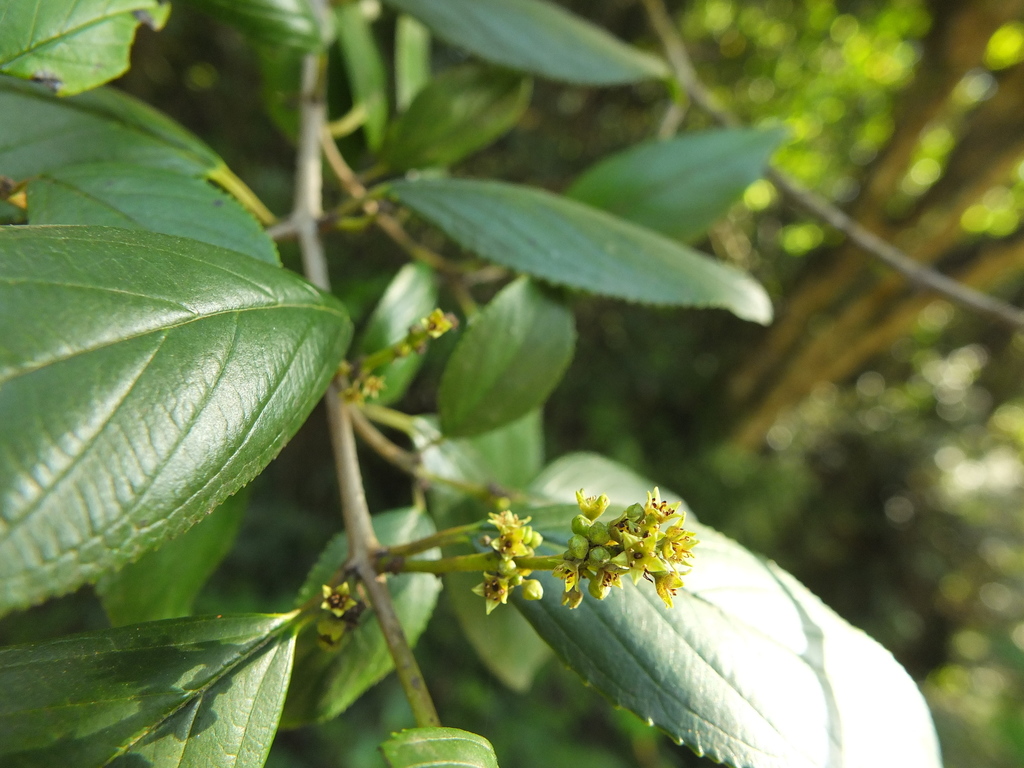
A small tree that grows near the sea coast. Trunk 9–12° high, straight, many-branched, devoid of thorns. Leaves alternate, ovate, acutely serrate, glabrous, short-petioled. Flowers greenish-white, axillary, perfect. Calyx 5-toothed, inversely conical. Corolla, 5 petals, smaller than the teeth of the calyx, oval, without claws, notched at the apex. Disc fleshy, smooth, slightly concave. Stamens 5, hidden within the petals. Filaments flattened. Anthers rounded. Ovary fleshy, inserted at the bottom of the calyx tube. Style short. Stigmas 3, divergent. Fruit oval, its base adherent to the calyx, 3 seeds.
Recent research
The most cited papers since 2018 that name this plant in the title, pulled from Europe PMC in October 2026. Titles are the authors' own and the findings have not been reviewed here.
All 1 results on Europe PMC