Sagdikit
Plumbago zeylanica · Ceylon leadwort
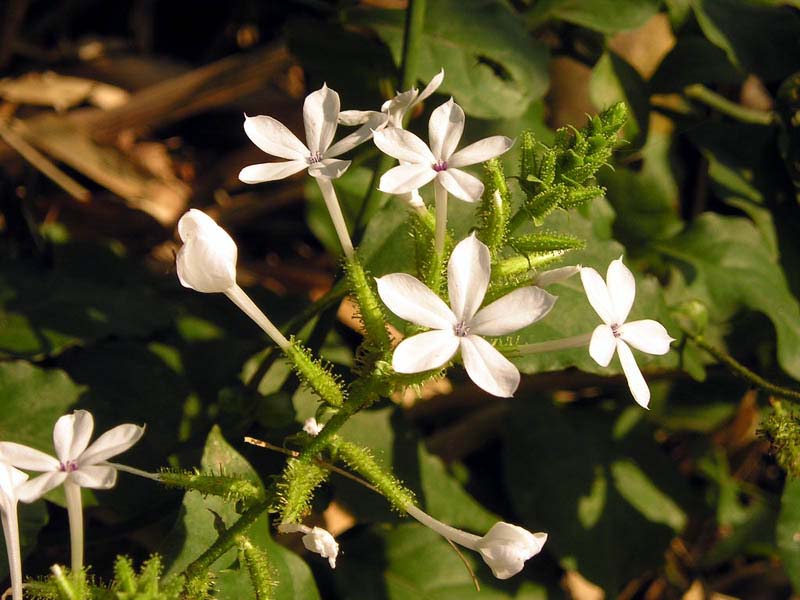
- Names in the book
- Sagdikit, Tag.; Bagbag, Talankaw, Iloc.; White-flowered Leadwort, Eng.
- Colours
- flowerwhite
- Native range
- Old World tropics
- In the Philippines, per the book
- In Tanauan (Batangas).
- Family
- Plumbaginaceae, filed in the book under Plumbagineæ
- Printed as
- Plumbago Zeylanica, L. (P. viscosa, Blanco.)
- Sources
- Page 155 on Project Gutenberg · Wikipedia
The plant today
Plumbago zeylanica, commonly known as Ceylon leadwort, doctorbush or wild leadwort, is a species of plumbago with a pantropical distribution. Carl Linnaeus described the paleotropical P. zeylanica and Neotropical P. scandens as separate species, but they are currently considered synonymous.
Excerpt from “Plumbago zeylanica” on Wikipedia, CC BY-SA 4.0.
Recorded in the Philippines
GBIF holds 34 records of this plant from the Philippines. The ones with map coordinates fall in 1 province: Batangas (3).
Counts from GBIF occurrence records, October 2026. They include planted trees and garden plants, and a province with no records may only lack collectors.
What the 1901 book says
A historical record, quoted as printed. Doses and remedies here are not medical advice.
Uses
The root is vesicant and is used by the natives for this purpose. (P. rosea, L., common in India, is more powerful. The Pharmacopœia of India states that both species are worthy of further investigation.) According to the Sanscrit authors it increases the appetite and is useful in dyspepsia, piles, dropsy, diarrhœa and skin diseases. The Filipinos use the infusion locally for itch with good results. A favorite medicine of the Hindoos for flatulence is the old recipe of Susrutas, composed of equal parts of the following substances in powder:
Leadwort root, root of Cissampelos Pareira, Picrorrhiza kurroa, Aconitum heterophyllum, and Terminalia Chebula in dose of 4 grams a day.
Dr. Oswald has employed the alcoholic tincture of leadwort in the intermittents, with satisfactory results, and claims that it is a powerful diaphoretic. The mashed root is mixed with rice flour and made into a caustic paste to apply to buboes, destroy warts, etc. Women also use the scraped root to induce abortion, introducing it through the vagina into the os uteri. This practice should be strongly condemned on account of its dangerous consequences—metritis, peritonitis and often death.
The chemical composition of the root has been studied by Dulong. It includes a non-nitrogenous principle, plumbagin, existing in the form of orange-yellow needles, bitter, acrid, volatile, neutral, slightly soluble in cold water, more soluble in ether, alcohol and hot water. The aqueous solution becomes cherry-red on the addition of an alkali, which color is changed to yellow by acids. Basic acetate of lead causes the same color change.
Botanical description
Plant with stem declined, angular. Leaves lanceolate, entire, rather downy. Petioles at their base embrace the stem. Flowers white, in axillary spikes. Individual involucres, 3 oval leaflets, the lower larger. Calyx long, cleft almost to the base in 5 lineal parts thickly set with small glands, exuding a sticky gum. Corolla salver-shaped, the tube long, square, throat bare, limb divided into 5 obovate parts, ending in stylets. Stamens 5, inserted near the base of the corolla, almost as long as the tube. Style a little shorter than the stamens. Stigma, 5 parts. One long seed enclosed within the calyx, pentangular, covered with a membranaceous skin.
Recent research
The most cited papers since 2022 that name this plant in the title, pulled from Europe PMC in October 2026. Titles are the authors' own and the findings have not been reviewed here.
- Biosynthesis and characterization of copper oxide nanoparticles from Plumbago zeylanica leaf extract for antibacterial and antioxidant activities
- Purification and structural characterization of two polysaccharides with anti-inflammatory activities from Plumbago zeylanica L
- Network pharmacology analysis of Plumbago zeylanica to identify the therapeutic targets and molecular mechanisms involved in ameliorating hemorrhoids