Kasubha
Carthamus tinctorius · Safflower
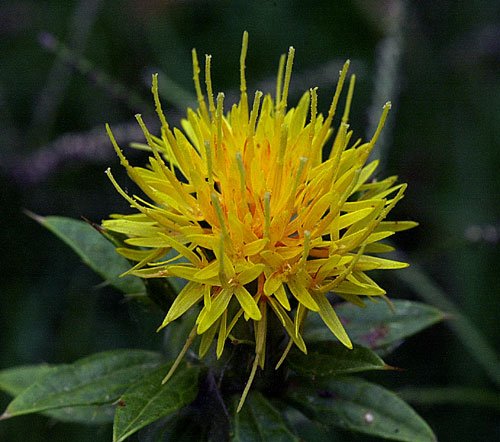
- Names in the book
- Azafrán de la tierra, Sp.; Biri, Kasubha, Katsumba, Lago, Tag.; Kasabba, Vis.; Kasubha, Kastumba, Pam.; Bastard Saffron, Dyer’s Safflower, Eng.
- Colours
- floweryellow, orange, red
- Native range
- Western Asia
- In the Philippines, per the book
- Cultivated in the gardens.
- Family
- Asteraceae, filed in the book under Compositæ
- Printed as
- Carthamus tinctorius, L.
- Sources
- Page 154 on Project Gutenberg · Wikipedia
The plant today
Safflower (Carthamus tinctorius), also false saffron, is a highly branched, herbaceous, thistle-like annual plant in the family Asteraceae. It is one of the world's oldest crops; today, it is commercially cultivated for vegetable oil extracted from the seeds. Plants are 30 to 150 cm (12 to 59 in) tall with globular flower heads having yellow, orange, or red flowers. Each branch will usually have from one to five flower heads containing 15 to 20 seeds per head. Safflower is native to arid environments having seasonal rain. It grows a deep taproot which enables it to thrive in such environments.
Excerpt from “Safflower” on Wikipedia, CC BY-SA 4.0.
Sa Tagalog
Ang kasubha (mula sa Sanskrito: कुसुम्भ [kusumbha]),(Ingles: safflower) o Carthamus tinctorius, isang uri ng carthamus na nasa pamilyang Asteraceae. Ito ay masangay, mala-damo, mala-dawag na taunang halaman. Itinatanim ito dahil sa mantika nito na hango sa mga buto nito. Ang mga halaman ay nasa 30 hanggang 150 sentimetro ang taas, na may mabilog na kumpol ng bulaklak na kadalasa'y may kulay pula, dilaw at kahel.
Sipi mula sa “Carthamus tinctorius” sa Tagalog Wikipedia, CC BY-SA 4.0.
Recorded in the Philippines
GBIF holds 20 records of this plant from the Philippines. The ones with map coordinates fall in 3 provinces: Cebu (1), Laguna (1), Negros Oriental (1).
Counts from GBIF occurrence records, October 2026. They include planted trees and garden plants, and a province with no records may only lack collectors.
What the 1901 book says
A historical record, quoted as printed. Doses and remedies here are not medical advice.
Uses
This plant must not be confounded with Curcuma longa, L., whose tuber is also frequently called saffron (azafrán), and is used to color food.
The flower is the part employed as a condiment coloring the food yellow. Some use them internally in doses of 4 grams to cure icterus. The leaves coagulate milk. The seeds are purgative in dose of 8–16 grams, bruised and taken in emulsion, or 15–30 grams in decoction.
The following is the chemical analysis of the plant:
[table omitted; see the source text]
(Salvetat.)
Botanical description
A plant 3° high, root gray and spindle-shaped. Stem straight, few branches. Leaves scattered, sessile, partially embracing the stem, lanceolate, serrate with hooked teeth. Flowers yellow, terminal in a sort of corymb. Common calyx semiglobose, with imbricated scales, the border often bearing thorns; numerous hermaphrodite disk flowers, with corolla very long, funnel-form, 5-toothed. Style longer than the stamens. Stigma bifid. Seed large, lacking pappus.
Recent research
The most cited papers since 2022 that name this plant in the title, pulled from Europe PMC in October 2026. Titles are the authors' own and the findings have not been reviewed here.
- Comprehensive review of two groups of flavonoids in Carthamus tinctorius L
- Investigating the therapeutic effects and mechanisms of Carthamus tinctorius L.-derived nanovesicles in atherosclerosis treatment
- Identification and Characterization of CtUGT3 as the Key Player of Astragalin Biosynthesis in Carthamus tinctorius L