Sampalok
Tamarindus indica · Tamarind
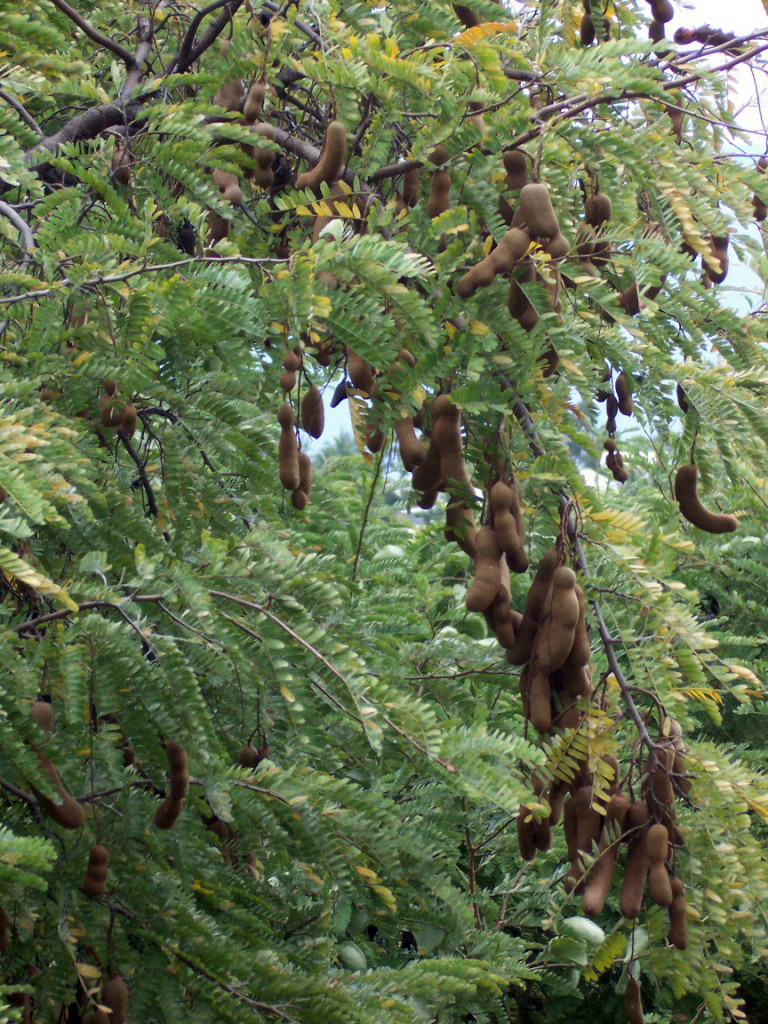
- Names in the 1901 book
- Tamarindo, Sp.; Sampalok, Tag., Pam., Bik.; Sambak, Sumalagi, Kamalagi, Vis.; Tamarind, Eng.
- Names in the 1985 book
- English: Tamarind; Tagalog: Sampalok; Bicol: Samabalagi, Sambak; Ilocano: Salamagi, Salomagi; Visayan: Sambi, Sambag
- Colours
- floweryellow, redfruitbrown
- Native range
- Tropical Africa
- In the Philippines, per the book
- Very common everywhere in the islands. Blooms in May.
- Family
- Fabaceae, filed in the book under Leguminosæ
- Printed in 1901 as
- Tamarindus Indica, L.
- Printed in 1985 as
- Tamarindus indica L.
- Sources
- Page 104 on Project Gutenberg · Healing Wonders of Herbs (1985), page 128 · Wikipedia
The plant today
Tamarind (Tamarindus indica) is a leguminous tree bearing edible fruit that is indigenous to tropical Africa and naturalized in Asia. The genus Tamarindus is monotypic, meaning that it contains only this species. It belongs to the family Fabaceae. The tamarind tree produces brown, pod-like fruits that contain a sweet, tangy pulp, which is used in cuisines around the world. The pulp is also used in traditional medicine and as a dye. The wood can be used for woodworking, and tamarind seed oil can be extracted from the seeds. Its young leaves are used in Indian and Filipino cuisine.
Excerpt from “Tamarind” on Wikipedia, CC BY-SA 4.0.
Sa Tagalog
Ang sampalok (Ingles: tamarind) ay isang uri ng tropikal na puno o maasim na prutas.
Sipi mula sa “Sampalok” sa Tagalog Wikipedia, CC BY-SA 4.0.
Recorded in the Philippines
GBIF holds 171 records of this plant from the Philippines. The ones with map coordinates fall in 26 provinces, most often Metropolitan Manila (15), Zamboanga del Norte (14), Bataan (6), Cebu (5), Davao del Sur (4), Davao Oriental (3), Batangas (2), Guimaras (2), and 18 more.
Counts from GBIF occurrence records, October 2026. They include planted trees and garden plants, and a province with no records may only lack collectors.
What the 1901 book says
A historical record, quoted as printed. Doses and remedies here are not medical advice.
Uses
The pulp of the fruit is used to make a sort of sweet preserve and is very popular among the Filipinos. They prepare a refreshing drink from the pulp mixed with sweetened water and believing it to be beneficial to the liver, stomach and blood, they use too much of it. Its excessive use is rather prejudicial to the health, but given in moderation it is very efficient in allaying the thirst of fever patients. The pulp contains weak laxative properties and it is customary to administer it in solution with cream of tartar. Its chemical composition is as follows:
[table omitted; see the source text]
(Vauquelin.)
At the end of any sickness, especially after labor, the first bath given to the convalescent is with a decoction of the leaves of the “sampaloc,” to prevent convulsions, the native herb-doctors say.
Botanical description
A large tree, somewhat resembling the elm in contour, with leaves opposite, abruptly pinnate. Leaflets 12 or more pairs, linear, with a notch at the apex, entire, glabrous. Flowers yellow-white, spattered dark red, racemose. Calyx, 4 sepals. Corolla, 5 lanceolate petals with crispate borders. Stamens monadelphous, dividing into 7 filaments above. The ripe pod is chocolate color, oblong, slightly compressed, straight or curved, 6–15 centimeters long, full of a light-brown pulp in which rest the seeds enveloped in a cellular membrane. These seeds are flattened, almost quadrangular; testa hard, of a chestnut color, shiny and without albumen.
What the 1985 book uses it for
A record of home remedies from 1985, with the book's amounts and doses reworded. It is not medical advice.
- AsthmaBark decoction, drunk.Chop a piece of bark about a foot long and boil in 3 glasses of water for 10 minutes. Adults take 1 cup after each meal and at bedtime. Children half a cup, babies 2 teaspoons, four times a day.Page 14
Summarised from Herminia de Guzman-Ladion, Healing Wonders of Herbs (Manila: Philippine Publishing House, 1985), where this plant is shown as “Sampalok” on page 128. The book is in copyright, so its wording and photographs are not reproduced. Amounts are the book's, restated.
Recent research
The most cited papers since 2022 that name this plant in the title, pulled from Europe PMC in October 2026. Titles are the authors' own and the findings have not been reviewed here.
- Comparative Metabolic Study of Tamarindus indica L.'s Various Organs Based on GC/MS Analysis, In Silico and In Vitro Anti-Inflammatory and Wound Healing Activities
- Inhibition of ice recrystallization by tamarind (Tamarindus indica L.) seed polysaccharide and molecular weight effects
- Isolation and characterization of microcrystalline cellulose from an agro-waste tamarind (Tamarindus indica) seeds and its suitability investigation for biofilm formulation