Igasud
Strychnos ignatii · St. Ignatius bean
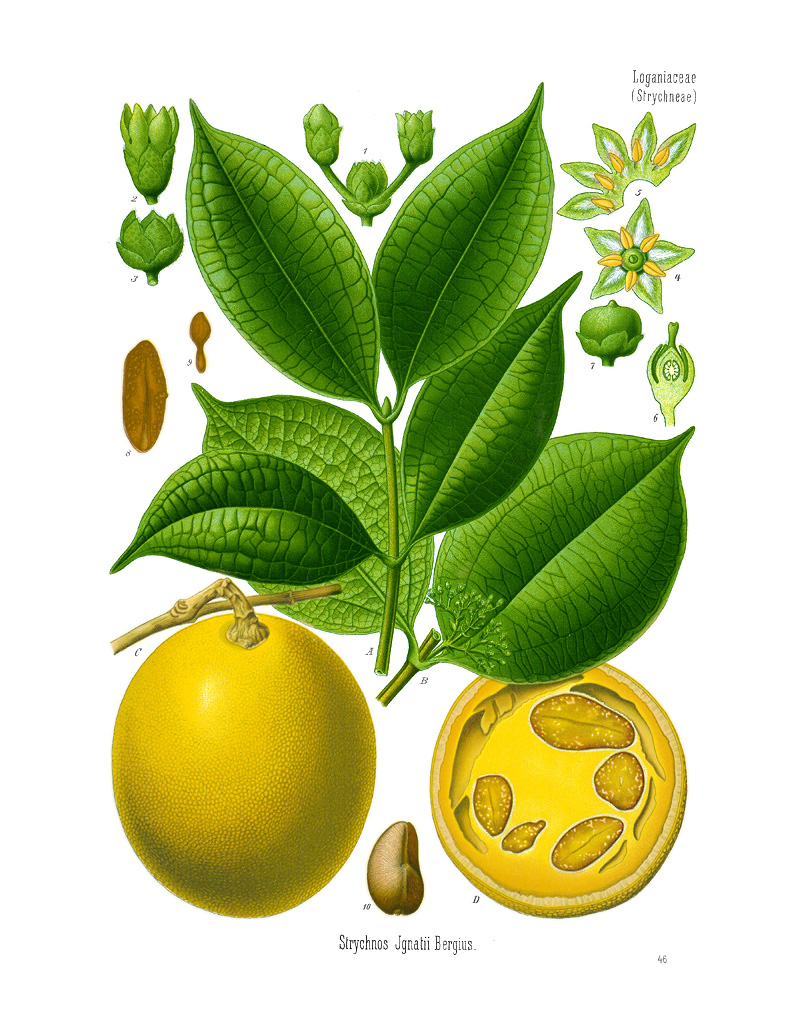
- Names in the book
- Pepita Fruta, Sp.-Fil.; Pepita sa katbalog̃an, Kabalog̃an, Tag., Pam.; Pangaguason, Aguason, Kanlara, Mananaog, Dankagi, Katalog̃a, Igasud, Vis.; St. Ignatius Bean, Eng.
- Colours
- flowergreenish-white
- Native range
- Philippines and nearby Southeast Asia
- Family
- Loganiaceae, filed in the book under Loganiaceæ
- Printed as
- Strychnos Ignatii, Berg. (S. Philippensis, Blanco; Ignatia amara, L.; Ignatia Philippinea, Lour.)
- Sources
- Page 171 on Project Gutenberg · Wikipedia
The plant today
Strychnos ignatii is a tree in the family Loganiaceae, native to the Philippines, particularly in Catbalogan and parts of China. The plant was first described by the Moravian (Czech) Jesuit working in the Philippines, brother Georg Kamel who named its seeds "the beans of St. Ignatius", in honour of the founder of his religious order.
Excerpt from “Strychnos ignatii” on Wikipedia, CC BY-SA 4.0.
Recorded in the Philippines
GBIF holds 61 records of this plant from the Philippines. The ones with map coordinates fall in 3 provinces: Agusan del Norte (2), Leyte (1), Northern Samar (1).
Counts from GBIF occurrence records, October 2026. They include planted trees and garden plants, and a province with no records may only lack collectors.
What the 1901 book says
A historical record, quoted as printed. Doses and remedies here are not medical advice.
Uses
The part of the plant employed is the seed, known in addition to the above common names as Pepita de San Ignacio and Pepita de Cabalonga (for katbolog̃an). The natives handle it with the greatest imprudence, selling everywhere in the markets and in the Chinese shops, called tindag̃-bayag̃. It is not only a remedy among them, but a sort of panacea, to which they attribute, among other virtues, that of expelling evil spirits, simply worn about the neck. They grate it with a piece of earthen pot, mix with a little “tuba” vinegar and apply it to the temples for headache. In bites of poisonous animals they advise the application of the powdered seed over the wound, a treatment which instead of being beneficent might easily be harmful to the patient. Before proceeding further, let us give the chemical composition of the seeds in order that their uses may be the better understood.
Strychnine is found in them in the proportion of ½–1½ and brucine ½%–1.4%. Flückiger and Hanbury by drying it over sulphuric acid and burning it with “cal sòdica” obtained 1.78% of nitrogen which represents 10% of albuminoid material. Strychnine and brucine exist in combination with igasuric acid discovered by Ludwig in 1873. The proportion of both the alkaloids is greater than in the seeds of nux vomica which contain only .25–.50% strychnine and .12–.05% brucin, although some authors give it as high as 1.01%. Strychnine can be obtained more readily and in larger proportions from St. Ignatius bean, but it is generally obtained from nux vomica seeds on account of the cheapness of the latter.
It is more energetic than nux vomica and its use in medicine should be condemned, preference, however, being given to the official preparations among which the best known is that commonly called “Bitter Drops of Beaumé,” of which the following is the composition:
[table omitted; see the source text]
Macerate for 10 days, strain, express and filter. Dose, 1–16 drops in a little water or wine before each meal, for dyspepsia, anæmia, convalescence from fevers, and other conditions in which a tonic is indicated. The indications for the use of this drug are the same as those for nux vomica, keeping in mind the difference in dose.
Botanical description
This plant grows in the deep forests of Samar and Masbate. That industrious and distinguished botanist, D. Regino García, found it growing abundantly in Paranas, Island of Samar. It is a robust vine, the trunk sometimes as thick as a man’s thigh, climbing to the tops of the highest trees, apparently without preference as to its host, inasmuch as he saw it growing indifferently on Ficus, Dipterocarpus, Litsaca, etc. The seed which most interests us and is very common, is about the size of an olive, round and convex on one side, angulose and flattened on the other by being compressed with many others within the fruit which contains 50 of them. Its surface is blackish with a gray-blue tinge. It is hard and corneous. Its taste is extremely bitter.
Branches opposite, smooth, the ends square. Leaves opposite, oval, much pointed at the apex, entire, glabrous, with 3 prominent nerves. Petioles very short. Flowers in panicles of many flowerets. Calyx inferior, 5-cleft, very short. Corolla 6–7 times longer than the calyx, funnel-form, 5-lobed. Anthers 5, sessile, fixed in the throat of the corolla. Ovary very small. Style filiform, same length as the stamens. Stigma truncate and thick. Drupe globose, often oval, large, smooth, with thick, woody shell of a single compartment containing seeds as described above.
Recent research
The most cited papers since 2018 that name this plant in the abstract, pulled from Europe PMC in October 2026. Titles are the authors' own and the findings have not been reviewed here.
- Negligible Nux Vomica: Homeopathic Nux Vomica remedies don't contain strychnine?
- What kind of poison was used in "The Name of the Rose"?