Linga
Sesamum indicum · Sesame
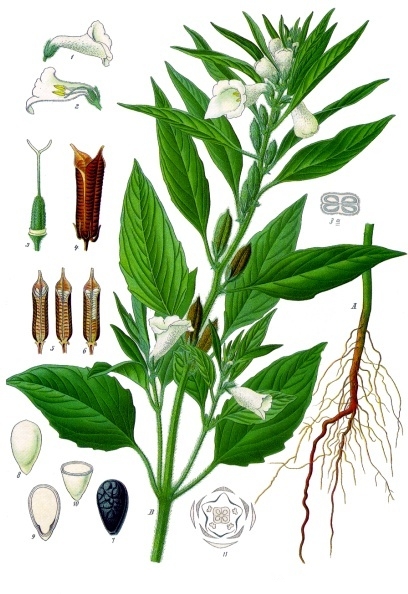
- Names in the book
- Ajonjoli, Sp.; Lig̃á, Tag.; Log̃á, Vis.; Lag̃is, Pam.; Sesamé, Indo-Eng. (Benné Oil, Til Oil, Jinjili Oil.)
- Used for
- ConstipationWounds, burns and boilsJoint pain, sprains and swellingUrinaryHemorrhoidsHair and scalpMenstruation and childbirth
- Colours
- flowerwhite, pinkseedcream, black
- Native range
- Domesticated in India
- In the Philippines, per the book
- Universal. Blooms in October.
- Family
- Pedaliaceae, filed in the book under Pedaliaceæ
- Printed as
- Sesamum Indicum, L.
- Sources
- Page 184 on Project Gutenberg · Wikipedia
The plant today
Sesame (; Sesamum indicum) is a plant in the genus Sesamum, also called benne. Numerous wild relatives occur in Africa and a smaller number in India. It is widely naturalized in tropical regions around the world and is cultivated for its edible seeds, which grow in pods. World production in 2024 was 6.7 million tonnes (7.4 million short tons), with India, Myanmar, and Sudan as the largest producers. Sesame seed is one of the oldest oilseed crops known, domesticated well over 3,000 years ago. Sesamum has many other species, most being wild and native to sub-Saharan Africa. S. indicum, the cultivated type, originated in India.
Excerpt from “Sesame” on Wikipedia, CC BY-SA 4.0.
Sa Tagalog
Ang linga (Sesamum indicum) ay isang uri ng halaman sa saring Sesamum. Marami itong ligaw na kamag-anak sa Aprika, at may mas maliit na bilang din sa Indiya. Naturalisado ito sa maraming tropikal na rehiyon sa buong mundo at itinatanim para sa mga nakakaing buto nito na lumalaki sa loob ng mga bayna ng halaman. Noong 2018, 6 milyong tonelada ang naiprodyus ng mundo, at pinakamarami ang naiprodyus ng Sudan, Myanmar, at Indiya.
Sipi mula sa “Linga” sa Tagalog Wikipedia, CC BY-SA 4.0.
Recorded in the Philippines
GBIF holds 81 records of this plant from the Philippines. The ones with map coordinates fall in 11 provinces, most often Zamboanga del Norte (14), Iloilo (8), Palawan (4), Zamboanga del Sur (2), Batangas (1), Benguet (1), Camarines Sur (1), Metropolitan Manila (1), and 3 more.
Counts from GBIF occurrence records, October 2026. They include planted trees and garden plants, and a province with no records may only lack collectors.
What the 1901 book says
A historical record, quoted as printed. Doses and remedies here are not medical advice.
Uses
The leaves are emollient and in the Philippines, India and the Southern States of North America they are commonly used to make poultices, as a substitute for linseed.
The decoction is prescribed internally as an emmenagogue and demulcent and externally as a lotion. It has the reputation of stimulating the growth of the hair and is used for this purpose quite commonly by the women of India.
The seeds are emollient, laxative, diuretic and emmenagogue; they contain an oil to which we shall refer presently. In some countries they form an article of diet; in the Philippines they are much used as a condiment. Waring reports good results in amenorrhœa, adding a handful of the bruised seeds to a hot sitz-bath. Two or 3 dessert-spoonfuls of the seeds eaten fasting and washed down with a glass of water, are very efficient in chronic constipation, both by their mechanical effect and the oil they contain; being non-irritant they are especially indicated in cases of constipation with hemorrhoids.
The seeds contain up to 45% of oil known in the Philippines under the name of lana, an Ilocano word meaning “oil.” It is bright yellow, viscid, does not easily become rancid and is used for illuminating purposes in some Philippine provinces. In Japan and among the poor of India it serves as a food; in the latter country it is also very commonly used as a cosmetic, perfumed with various essences and used to anoint the hair and the body after the bath. In America it is given in place of castor oil in doses of 30–60 grams. In pharmacy it may be properly substituted for olive oil, especially in Linimentum Calcis prepared for burns.
Botanical description
A plant 2–4° high, stem straight, square, grooved. Leaves trifoliate. Leaflets lanceolate, serrate, slightly downy. Common petiole long; secondary petiole very short. Flowers pinkish white, in spikes, each flower bearing 2 small glands. Calyx with 2 bracts at the base, top-shaped, monophyllous, 5 lanceolate teeth. Corolla large, 5-lobed, bell-shaped, expanded in the middle where it is spattered with small spots. Stamens didynamous. Anthers long. Ovary downy, quadrangular. Style same length as stamens. Stigma bifid. Seed vessel quadrangular, elongated, 4 opposite grooves, 4 chambers each containing many small ovoid seeds.
Recent research
The most cited papers since 2022 that name this plant in the title, pulled from Europe PMC in October 2026. Titles are the authors' own and the findings have not been reviewed here.
- Sesame (Sesamum indicum L.): A Comprehensive Review of Nutritional Value, Phytochemical Composition, Health Benefits, Development of Food, and Industrial Applications
- Widely targeted metabolome profiling of different colored sesame (Sesamum indicum L.) seeds provides new insight into their antioxidant activities
- Effects of sesame (Sesamum indicum L.) and bioactive compounds (sesamin and sesamolin) on inflammation and atherosclerosis: A review