Red sandalwood
Pterocarpus santalinus
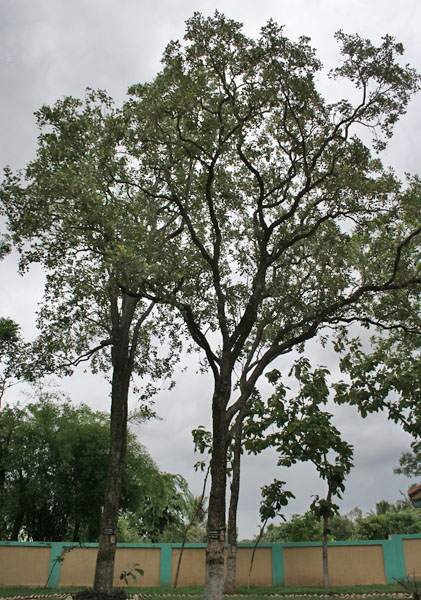
- Names in the book
- Narra, Naga, Tag.; Apalit, Daytanag, Pam.; Red Saunders or Red Sandalwood Tree, Eng.
- Used for
- Mouth, teeth and throatDiarrhea and dysenteryWounds, burns and boilsUrinaryMenstruation and childbirth
- Colours
- floweryellowwoodred
- Native range
- Eastern Ghats, southern India
- In the Philippines, per the book
- In the mountains of Luzon, Panay and Mindoro. Blooms in March.
- Family
- Fabaceae, filed in the book under Leguminosæ. (Papilionaceæ.)
- Printed as
- Pterocarpus santalinus, L.
- Sources
- Page 93 on Project Gutenberg · Wikipedia
The plant today
Pterocarpus santalinus, with the common names red sanders, red saunders, Yerra Chandanam, Chenchandanam, red sandalwood, Rakta Chandana, and rakto chandon, is a species of Pterocarpus endemic to the southern Eastern Ghats mountain range of South India. It is known for its red colour and has been used for furniture, musical instruments, and traditional herbal medicine. Because of the high market value for its timber, the species has been overexploited, and illegal trade remains a problem. It is listed as endangered on the IUCN Red List. It should not be confused with the aromatic Santalum sandalwood trees native to southern India.
Excerpt from “Pterocarpus santalinus” on Wikipedia, CC BY-SA 4.0.
Recorded in the Philippines
GBIF holds no records of this plant from the Philippines.
Checked against GBIF occurrence records, October 2026.
What the 1901 book says
A historical record, quoted as printed. Doses and remedies here are not medical advice.
The book gives one account for this plant and Asana (Pterocarpus erinaceus) and Narra (Pterocarpus Indicus), so the text below appears on each page.
Uses
The wood of the first is the so-called “red sandalwood.” It is used for building purposes and, in medicine, as an astringent. In decoction it is used as a gargle for sore throat. The second is also an excellent building material and is used medicinally for its astringent properties. A decoction of sufficient strength to color the water a light blue is used as a mouth wash in toothache and has some reputation as a solvent of vesical calculi. All three species yield a resin known in pharmacy under the name of “kino.” The true gum kino is really produced by the P. marsupium, Roxb., but the Philippine product, especially that of the second and third species, has for a long time been exported to Europe under the name of “red astringent gum” or “kino.” This name is given to the sap of these trees dried without the aid of artificial heat. The bark is the part which produces it and the following extractive process is employed in Madras: a vertical incision is made in the trunk and lateral incisions perpendicular to it and a receptacle is placed at the foot of the tree. This soon fills and when the gum is sufficiently dried by air and sun it is packed in boxes and exported.
In respect to appearance, solubility and chemical composition, Flückiger and Hanbury were unable to discover any difference between the kino of P. marsupium, Roxb., and that of P. erinaceus, Poir. It is therefore interesting to consider a product that is identical with that described in the pharmacopœias as produced by the P. marsupium, Roxb., though the latter does not grow in the Philippines.
Kino is at present used but little in therapeutics and its action is analogous to that of tannin and catechu. It is given internally for its astringent effect in chronic diarrhœa, leucorrhœa, blenorrhœa and hemorrhages. The dose of the powder is 1–4 grams, and of the alcoholic tincture, containing 20 parts kino to 100 of alcohol, 5–10 grams. In prolapse of the rectum and anal fissure the following solution is used by enema:
[table omitted; see the source text]
For vaginal injections a solution of 20 to 250 water.
Botanical description
The “pterocarpus,” L., is a tree of the first order with odd-pinnate leaves. Leaflets alternate and coriaceous. Flowers yellow, in racemes, with caducous bracts and bractlets. Calyx turbinate, with short teeth. Petals exserted, markedly unguiculate. Standard and wings curled. Keel obtuse with its petals slightly or not at all coherent. The staminal tube, cleft above and below or above only. Stamens superior, often almost, and at times entirely, free. Anthers versatile. Ovary pedunculate, with 2 ovules. Style curved. Stigma terminal. Pod orbicular, smooth or spiny, usually containing one seed, encircled by a broad, rigid wing, the point curved downward.
Recent research
The most cited papers since 2022 that name this plant in the title, pulled from Europe PMC in October 2026. Titles are the authors' own and the findings have not been reviewed here.
- Essential oil of Pterocarpus santalinus L. alleviates behavioral impairments in social defeat stress-exposed mice by regulating neurotransmission and neuroinflammation
- Discovery of anti-SARS-CoV-2 secondary metabolites from the heartwood of Pterocarpus santalinus using multi-informative molecular networking
- Potential planting regions of Pterocarpus santalinus (Fabaceae) under current and future climate in China based on MaxEnt modeling