Paminta
Piper nigrum · Black pepper
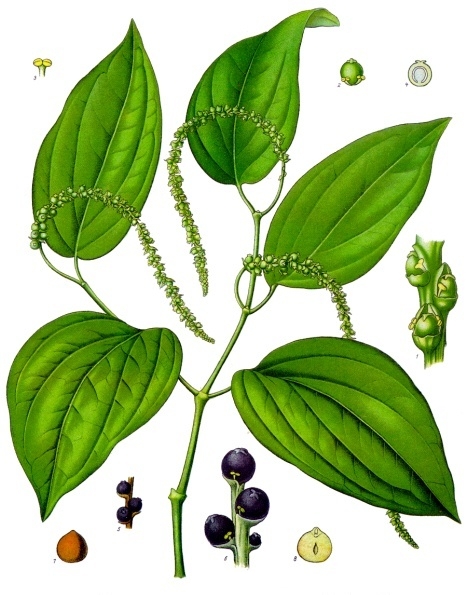
- Names in the book
- Pimienta, Sp.; Paminta, Malisa, Tag.; Black Pepper, Eng.
- Used for
- FeverStomach and digestion
- Colours
- flowercreamfruitgreen, red, black
- Native range
- Western Ghats, southwest India
- In the Philippines, per the book
- The dried fruit of the pepper is universally familiar. It was at one time cultivated in the Philippines, especially in Batangas, and Gen.
- Family
- Piperaceae, filed in the book under Piperaceæ
- Printed as
- Piper nigrum, L.
- Sources
- Page 206 on Project Gutenberg · Wikipedia
The plant today
Black pepper (Piper nigrum) is a flowering vine in the family Piperaceae, cultivated for its fruit (the peppercorn), which is usually dried and used as a spice and seasoning. The fruit is a drupe (stonefruit) which is about 5 mm (1⁄4 in) in diameter (fresh and fully mature), dark red, and contains a stone which encloses a single pepper seed. Peppercorns and the ground pepper derived from them may be described simply as pepper, or more precisely as black pepper (cooked and dried unripe fruit), green pepper (dried unripe fruit), or white pepper (ripe fruit seeds). Black pepper is native to South Asia.
Excerpt from “Black pepper” on Wikipedia, CC BY-SA 4.0.
Sa Tagalog
Ang paminta (Piper nigrum) ay isang namumulak na baging sa pamilya Piperaceae, na nilinang sa prutas nito, na karaniwan ay tuyo at ginagamit bilang pampalasa at panimpla. Kapag tuyo, ang bunga ay kilala bilang isang paminta. Kapag sariwa at ganap na mature, humigit-kumulang 5 mm (0.20 in) ang lapad, madilim na pula, at, tulad ng lahat ng mga drupe, ay naglalaman ng isang binhi.
Sipi mula sa “Paminta” sa Tagalog Wikipedia, CC BY-SA 4.0.
Recorded in the Philippines
GBIF holds 115 records of this plant from the Philippines. The ones with map coordinates fall in 14 provinces, most often Agusan del Sur (50), Batangas (5), Bukidnon (2), Cavite (2), La Union (2), Nueva Ecija (2), Zamboanga del Sur (2), Batanes (1), and 6 more.
Counts from GBIF occurrence records, October 2026. They include planted trees and garden plants, and a province with no records may only lack collectors.
What the 1901 book says
A historical record, quoted as printed. Doses and remedies here are not medical advice.
Uses
The berry-like fruit of the pepper is more extensively used as a condiment in cooking than in the treatment of disease. Used in moderation, however, it is of considerable value as a convenient stomachic and aid to digestion in tropical countries where the digestive functions readily become sluggish. Its abuse may lead to serious consequences, such as inflammation of the gastro-intestinal mucous membrane, of the portal system and the liver itself.
Pepper is used as a febrifuge in the various forms of malarial fevers, in the form of granules of 8 or 10 berries in a cup of brandy and anise (Spanish); this is taken by the patient in one dose at the beginning of the cold stage and followed by large quantities of water to relieve the thirst caused by the pepper. This treatment causes the cold stage to rapidly subside and more rapidly induces and intensifies the sweating stage. It is said that no further attack of fever follows.
Piperin (C17H19NO3) is febrifuge and is given in pill form internally in doses of 30–60 centigrams; the action of the crude drug is evidently due to this neutral principle.
Botanical description
The plant is a perennial, climbing shrub. Leaves oval, tapering at both extremities, 7-nerved. Flowers yellow, in a spike. Stigmas 2, bifid. Fruit globose, with one seed.
Habitat
The dried fruit of the pepper is universally familiar. It was at one time cultivated in the Philippines, especially in Batangas, and Gen. Basco promulgated a series of orders to encourage its cultivation. Padre Gainza, afterward Bishop of Nueva Cáceres, wrote a report about its cultivation, but since then the subject has entirely disappeared from notice.
Recent research
The most cited papers since 2022 that name this plant in the title, pulled from Europe PMC in October 2026. Titles are the authors' own and the findings have not been reviewed here.
- Piperine Derived from Piper nigrum L. Inhibits LPS-Induced Inflammatory through the MAPK and NF-κB Signalling Pathways in RAW264.7 Cells
- Amide alkaloids characterization and neuroprotective properties of Piper nigrum L.: A comparative study with fruits, pericarp, stalks and leaves
- Ultrasound-assisted extraction, optimization, characteristics and antioxidant activity of Piper nigrum L. polysaccharides