Saging
Musa × paradisiaca · Banana
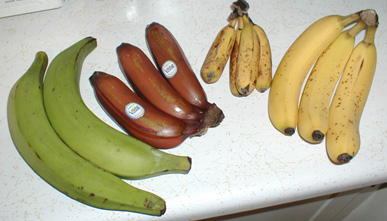
- Names in the book
- Plátano, Sp.; Sagig̃, Tag., etc.; Banana, Eng.
- Colours
- flowercreambractpurplefruityellow
- Native range
- Domesticated in Southeast Asia and New Guinea
- In the Philippines, per the book
- Common everywhere in the islands.
- Family
- Musaceae, filed in the book under Musaceæ
- Printed as
- Musa sapientum, L.
- Sources
- Page 227 on Project Gutenberg · Wikipedia
Musa sapientum is an old name for the sweet dessert bananas, now folded into Musa × paradisiaca.
The plant today
A banana is an elongated, edible fruit that is botanically a berry produced by several kinds of large treelike herbaceous flowering plants in the genus Musa. In some countries, cooking bananas are called plantains, distinguishing them from dessert bananas. The fruit is variable in size, color and firmness, but is usually elongated and curved, with soft flesh rich in starch covered with a peel, which may have a variety of colors when ripe. It grows upward in clusters near the top of the plant. Almost all modern edible seedless (parthenocarp) cultivated bananas come from two wild species – Musa acuminata and Musa balbisiana, or their hybrids.
Excerpt from “Banana” on Wikipedia, CC BY-SA 4.0.
Sa Tagalog
Ang saging ay isang pahabang nakakain na bunga—botanikal na isang pagla (berry)—na binubunga ng ilang uri ng malalaking mala-damo na halamang namumulaklak sa patirang Musa. Sa ilang mga bansa, tinatawag na plantano ang panlutong saging, na ipinagkakaiba mula sa mga saging na panghimagas.
Sipi mula sa “Saging” sa Tagalog Wikipedia, CC BY-SA 4.0.
Recorded in the Philippines
GBIF holds 223 records of this plant from the Philippines. The ones with map coordinates fall in 38 provinces, most often Zamboanga del Norte (21), Bataan (15), Rizal (15), Benguet (8), Batanes (6), Guimaras (6), Bukidnon (5), Laguna (4), and 30 more.
Counts from GBIF occurrence records, October 2026. They include planted trees and garden plants, and a province with no records may only lack collectors.
What the 1901 book says
A historical record, quoted as printed. Doses and remedies here are not medical advice.
The book gives one account for this plant and Saging (Musa paradisiaca), so the text below appears on each page.
Uses
The fruit produced by the various varieties of the banana plant constitutes one of the most wholesome and delicious of foods, appreciated by natives and Europeans alike. According to Boussingaul its nutritive value is greater than that of the potato and it may be used constantly without ill effects. Bananas contain a large percentage of sugar and mucilage. In India they dry them in the sun, as figs and grapes are treated in other countries and thus preserve them for long voyages by sea or land; eaten in conjunction with animal food they are a strong preventive of scurvy. If eaten when thoroughly ripe they have a laxative effect.
The young and tender leaves are used in the Philippines as a protective dressing for ulcers, dermatitis, burns and cantharidal or other artificial blisters. Before applying to the affected surface the leaf is heated to make it more flexible and coated with a thin layer of cocoanut oil or other fatty substance.
In the dispensaries of India they also use the leaves in this way, thus protecting and at the same time maintaining the moisture of the part. Dr. Waring recommends the practice and Dr. Van Someren follows it in the application of water dressings, having substituted banana leaves for gutta-percha.
In Mauritius the fruit is used for dysentery, and the flowers, together with an equal quantity of those of Spilanthes Acmella, are made into a decoction and prescribed for dropsy.
Botanical description
The banana plant with its huge waving leaves and succulent stem is universally familiar. The flower stalk rises through the center developing a drooping spike, the flowers in short rows in the axils of its large purplish bracts. According to Blanco there are 57 varieties of this plant in the Philippines, the following being the most common edible varieties: bug̃ulag̃, lakatan, letondag̃, obispo, higo, morado, butuan, bentikohol, sabá, tampuhig̃.
Recent research
The most cited papers since 2022 that name this plant in the title, pulled from Europe PMC in October 2026. Titles are the authors' own and the findings have not been reviewed here.
- Antimicrobial activities of biosynthesized nanosilver using Musa paradisiaca and Citrus sinensis peel extracts against major human and plant pathogens
- Palmitic acid of Musa Paradisiaca induces apoptosis through caspase-3 in human oral squamous cell carcinoma
- Development and Characterization of Plantain (Musa paradisiaca) Flour-Based Biopolymer Films Reinforced with Plantain Fibers