Amugis
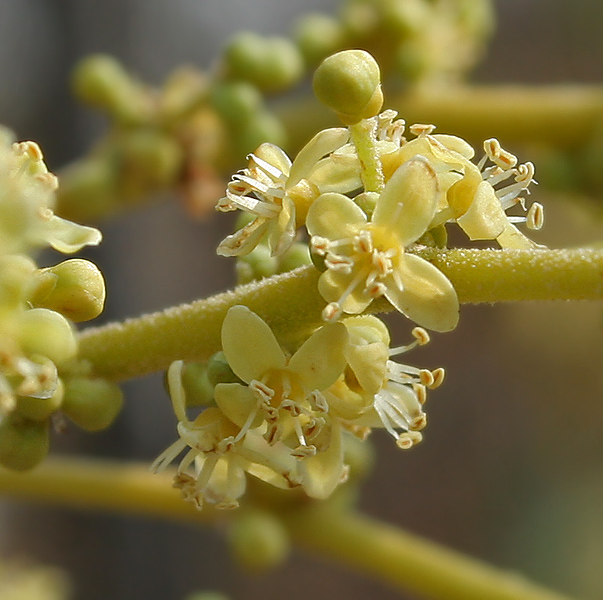
Lannea coromandelica · Indian ash tree
- Names in the book
- Amugis, Tag. and Vis.
- Colours
- flowergreenish-yellowfruitred
- Native range
- South and Southeast Asia
- In the Philippines, per the book
- San Mateo.
- Family
- Anacardiaceae, filed in the book under Anacardiaceæ
- Printed as
- Odina Wodier, Roxb.
- Sources
- Page 86 on Project Gutenberg · Wikipedia
The plant today
Lannea coromandelica, also known as the Indian ash tree, is a species of tree in the family Anacardiaceae that grows in South and Southeast Asia, ranging from Sri Lanka to Southern China. Known also as the Mohin tree (Hindi: मोहिन) it is used in plywoods for its excellent termite resistance properties. It commonly grows in exposed dry woodland environments, where the tree is up to 10 meters tall and crooked. In more humid environments it is a larger spreading tree that can become 20 meters tall. In Sri Lanka Lannea coromandelica often grows on rock outcrops or inselbergs.
Excerpt from “Lannea coromandelica” on Wikipedia, CC BY-SA 4.0.
Recorded in the Philippines
GBIF holds no records of this plant from the Philippines.
Checked against GBIF occurrence records, October 2026.
What the 1901 book says
A historical record, quoted as printed. Doses and remedies here are not medical advice.
Uses
The bark is very astringent and in decoction is used for chronic ulcers. In India Dr. Kirkpatrick has used it as a lotion in impetigo. It has also given good results as a gargle in affections of the pharynx and buccal cavity.
The trunk exudes a gum called in India “kanni ki gond,” an article of commerce. It is almost odorless and has a disagreeable taste. It is only partially soluble in water, forming a viscid mucilage. It is used in the treatment of contusions and sprains and is edible when mixed with cocoanut milk.
Botanical description
A tree, with leaves bunched at the extremities of the branches, oblong, oval, acuminate, odd-pinnate, 3–4 pairs of opposite leaflets. Flowers greenish-white, polygamous, in terminal panicles. Calyx gamosepalous, 4 rounded lobules. Corolla, 4 imbricated petals. Stamens 8, free. Ovary 4-parted. Pistillate flowers; ovary sessile, oblong, unilocular. Style 4-parted, thick. Drupe oblong, compressed, unicellular. Testa hard, with 1 non-albuminous kernel.
Recent research
The most cited papers since 2022 that name this plant in the title, pulled from Europe PMC in October 2026. Titles are the authors' own and the findings have not been reviewed here.
- Neuropharmacological and Antidiabetic Potential of Lannea coromandelica (Houtt.) Merr. Leaves Extract: An Experimental Analysis
- Antimicrobial and biocompatibility nature of methanol extract of Lannea coromandelica bark and edible coating film preparation for fruit preservation
- Antibacterial, antidiabetic, acute toxicity, antioxidant, and nephroproductive competence of extracts of Lannea coromandelica fruit through in-vitro and in-vivo animal model investigation