Upo
Lagenaria siceraria · Bottle gourd
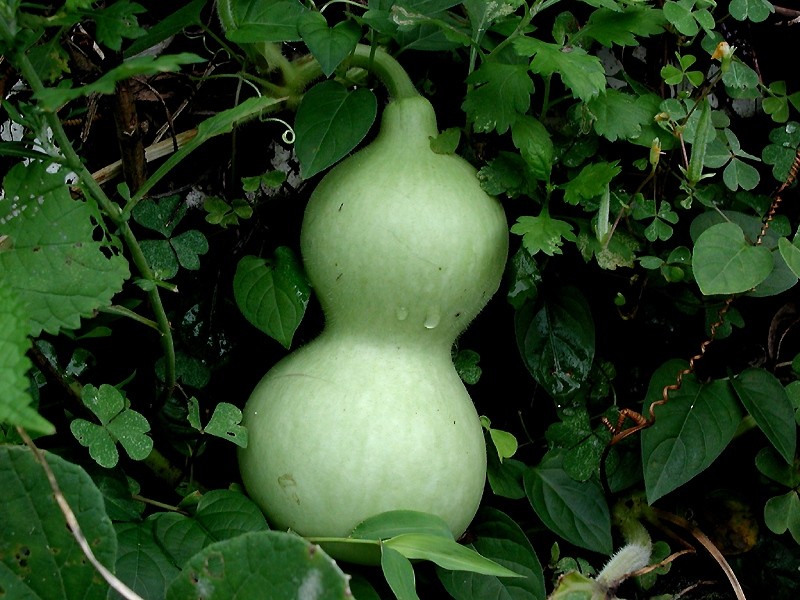
- Names in the book
- Calabaza blanca, Sp.; Opo, Tag.; White Gourd, Eng.
- Used for
- Cough and asthmaConstipation
- Colours
- flowerwhitefruitgreen
- Native range
- Africa
- Family
- Cucurbitaceae, filed in the book under Cucurbitaceæ
- Printed as
- Lagenaria vulgaris, Ser.
- Sources
- Page 129 on Project Gutenberg · Wikipedia
The plant today
Calabash (; Lagenaria siceraria), also known as bottle gourd, white-flowered gourd, long melon, birdhouse gourd, New Guinea bean, New Guinea butter bean or Tasmania bean, is a vine which is grown for its fruit. It belongs to the family Cucurbitaceae, is native to tropical Africa, and cultivated across the tropics. It can be either harvested young to be consumed as a vegetable, or harvested mature to be dried and used as a kitchen utensil (typically as a ladle or bowl), beverage container or a musical instrument. When it is fresh, the fruit has a light green smooth skin and white flesh.
Excerpt from “Calabash” on Wikipedia, CC BY-SA 4.0.
Sa Tagalog
Ang úpo (Lagenaria siceraria; Ingles: calabash) ay isang uri ng halamang baging o gumagapang na may mga mahahaba at mapuputing bunga na kahugis ng batuta. Nagagamit sa pagluluto ang bungang ito.
Sipi mula sa “Upo” sa Tagalog Wikipedia, CC BY-SA 4.0.
Recorded in the Philippines
GBIF holds 168 records of this plant from the Philippines. The ones with map coordinates fall in 5 provinces: Zamboanga del Norte (21), Guimaras (2), Bataan (1), Davao del Sur (1), Rizal (1).
Counts from GBIF occurrence records, October 2026. They include planted trees and garden plants, and a province with no records may only lack collectors.
What the 1901 book says
A historical record, quoted as printed. Doses and remedies here are not medical advice.
Uses
Var. Lagenaria Gourda, Ser. (Cucurbita lagenaria oblonga, Blanco.)
Var. L. courgourda, Ser.
Var. L. clavata, Ser. (C. lagenaria villosa, Blanco.)
The three above-mentioned varieties of L. vulgaris, Ser., are commonly grouped under the name calabaza (gourd). All have the same action and hence the same therapeutic application. The green portion of the rind is bitter and possesses purgative and emetic properties. The decoction of the tender shoots is expectorant; in addition it appears to possess purgative properties and in India is used in jaundice.
The part of the plant most generally used is the seeds, the tænifuge properties of which are well known. Its action, however, is not always certain, which may be as truly said of all other known tænifuges. The seeds have the advantage of lacking the disgusting taste characteristic of other remedies of the same class; the taste is almost neutral and a little sugar conceals it completely. The dose is unlimited; some take 15 grams, others as high as 100, and no unpleasant symptoms of any kind have been reported. The only precaution to be observed is to give the patient a purgative 1–2 hours after his dose.
Heckel has analyzed the seeds and found a resin which he calls pepo-resina; it exists in the greenish pellicle that envelopes the embryo and appears to be the active principle of the seeds. Its dose is 0.80–1.00 gram (Dujardin-Beaumetz), the product of 250 grams of the seeds. The dose of 100 grams of the seeds mentioned above is very small, if the pepo-resin represents the entire active principle, for 100 grams of the seeds would only contain about 40 centigrams.
Botanical description
A very familiar vine, clammy, pubescent and musk-scented; large leaves, long-stalked flowers, white petals, greenish veiny fruit usually club-shaped or enlarged at the apex, the hard rind used for vessels, dippers, and so forth. It is noteworthy that none of the tænifuge varieties mentioned bears yellow fruit.
Recent research
The most cited papers since 2022 that name this plant in the title, pulled from Europe PMC in October 2026. Titles are the authors' own and the findings have not been reviewed here.
- Lagenaria siceraria fruit: A review of its phytochemistry, pharmacology, and promising traditional uses
- Forward genetic studies reveal LsAPRR2 as a key gene in regulating the green color of pericarp in bottle gourd (Lagenaria siceraria)
- How Does Lagenaria siceraria (Bottle Gourd) Metabolome Compare to Cucumis sativus (Cucumber) F. Cucurbitaceae? A Multiplex Approach of HR-UPLC/MS/MS and GC/MS Using Molecular Networking and Chemometrics