Tuba
Jatropha curcas · Physic nut
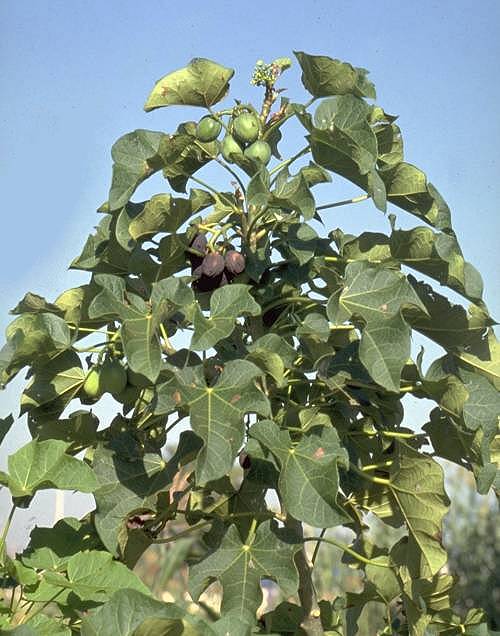
- Names in the book
- Tuba, Tag.; Kasla, Vis.; Tawatawa, Iloc. (Seeds called “English Physic Nuts” in India.)
- Colours
- flowergreenish-yellowfruityellow, black
- Native range
- Mexico and Central America
- In the Philippines, per the book
- Luzon and Visayas.
- Family
- Euphorbiaceae, filed in the book under Euphorbiaceæ
- Printed as
- Jatropha Curcas, L.
- Sources
- Page 215 on Project Gutenberg · Wikipedia
The plant today
Jatropha curcas is a species of flowering plant in the spurge family, Euphorbiaceae, that is native to the American tropics: Mexico, the Caribbean and Central and South America. It has been spread to tropical and subtropical regions around the world, becoming naturalized or invasive in many areas. The specific epithet, "curcas", was first used by Portuguese physician and naturalist Garcia de Orta more than 400 years ago. Common names in English include physic nut, Barbados nut, poison nut, bubble bush or purging nut.
Excerpt from “Jatropha curcas” on Wikipedia, CC BY-SA 4.0.
Recorded in the Philippines
GBIF holds 309 records of this plant from the Philippines. The ones with map coordinates fall in 46 provinces, most often Zamboanga del Norte (63), Agusan del Sur (45), Zamboanga del Sur (11), Cavite (9), Davao del Sur (9), Iloilo (9), Batanes (8), Metropolitan Manila (8), and 38 more.
Counts from GBIF occurrence records, October 2026. They include planted trees and garden plants, and a province with no records may only lack collectors.
What the 1901 book says
A historical record, quoted as printed. Doses and remedies here are not medical advice.
Uses
The milky juice of the trunk and branches is a drastic purgative, too active for safety as a physic. Mixed with water it is used as a wash for atonic ulcers.
The seeds yield 25–30 per cent. of a yellowish oil, more active than castor oil as a purgative but less certain. Ten or twelve of the former equal in effect 30 to 40 drops of the latter. Its density is 0.919, and it differs from castor oil in being only slightly soluble in absolute alcohol. In some parts of the Philippines it is used for purposes of illumination, and it is exported to Europe to adulterate soaps and candles. It contains a little stearin which begins to be deposited at 9° and is entirely solidified at 0°.
The fruit is strongly purgative, and this action is not due to the oil but to a peculiar resin so active that 3 fruits produce drastic effects. Whatever purgative action the oil possesses is due to the resin which it contains in solution. It seems, therefore, preferable to treat the seeds with alcohol, thus dissolving the resin, and use the tincture thus obtained in place of the oil.
The natives use the plant to intoxicate the fish in ponds and sluggish streams.
The seeds of the species J. multifida, L., also called tuba in Tag., and mana, are likewise purgative in their action. Dr. Waring saw a case of poisoning with the fruit; the patient, a young man, suffered violent vomiting, intense pain in the stomach and head, and marked prostration. He recovered under the use of lime juice and stimulants.
Botanical description
The J. Curcas is a small tree growing as high as 9°. Leaves alternate, cordate, glabrous, 3–5 cut-lobed. Flowers yellowish-green, monœcious, in terminal umbels, staminate and pistillate flowers mingled without order. Staminate: Calyx, 5 unequal sepals; corolla bell-shaped, 5 petals, woolly within, a small notch at the end, bent downward; stamens 10, in 2 whorls of 5. Pistillate: Calyx and corolla as above; several tongue-like staminodes replace the stamens; ovary free, oblong, 3-celled, 1 ovule in each cell; style 3-branched. Seed vessel fleshy, of 3 capsules, each bearing 1 oval, coriaceous seed.
Recent research
The most cited papers since 2022 that name this plant in the title, pulled from Europe PMC in October 2026. Titles are the authors' own and the findings have not been reviewed here.
- Reversible down-regulation of photosystems I and II leads to fast photosynthesis recovery after long-term drought in Jatropha curcas
- Characterization of saponins from the leaves and stem bark of Jatropha curcas L. for surface-active properties
- Identification, Phylogeny, Divergence, Structure, and Expression Analysis of A20/AN1 Zinc Finger Domain Containing Stress-Associated Proteins (SAPs) Genes in Jatropha curcas L