Mangostan
Garcinia mangostana · Mangosteen
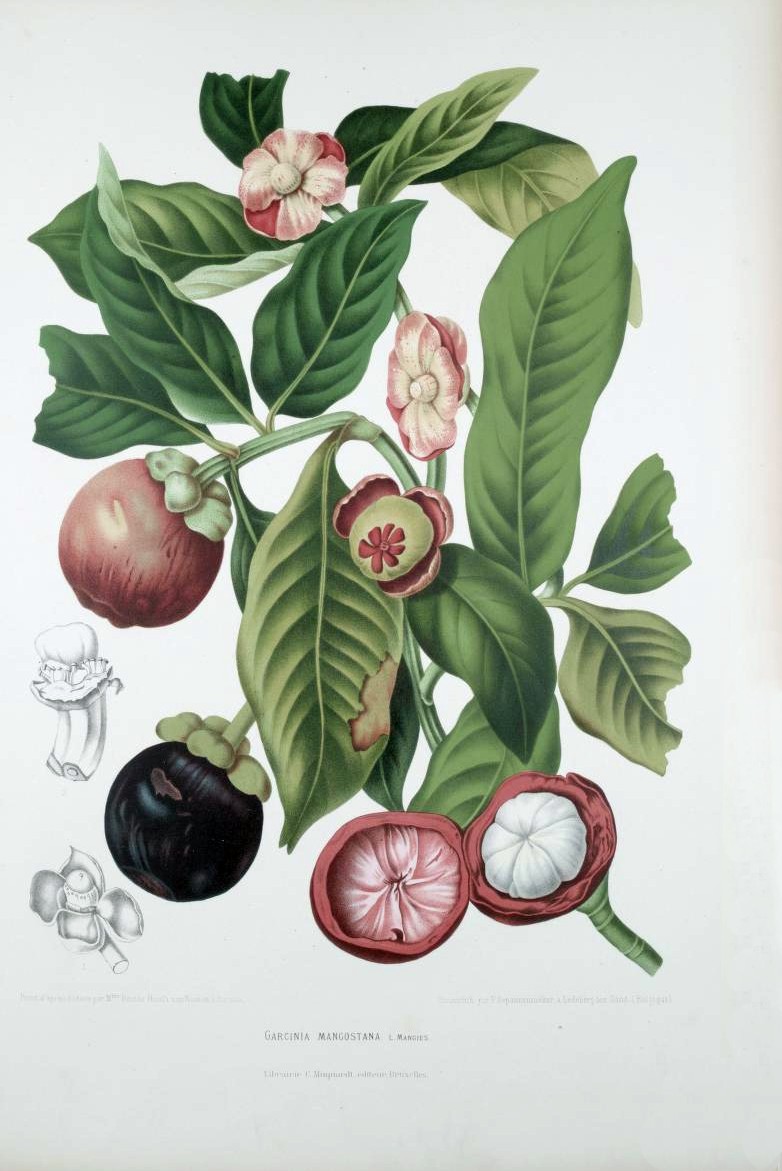
- Names in the book
- Mangostán, Sp.; Mangosteen, Eng.
- Colours
- flowerpink, yellowfruitpurple
- Native range
- Malay Peninsula and Borneo
- Family
- Clusiaceae, filed in the book under Guttiferæ
- Printed as
- Garcinia mangostana, L.
- Sources
- Page 35 on Project Gutenberg · Wikipedia
The plant today
Mangosteen (Garcinia mangostana), also called mangostan or purple mangosteen, is a tropical evergreen tree growing from 6 to 25 metres (20 to 82 feet) tall. The edible endocarp of the fruit is encased in an inedible purplish rind. The species is native to the Malay Peninsula and Borneo. It has been cultivated extensively in tropical Asia since ancient times. It is grown mainly in Southeast Asia, southwest India and other tropical areas such as Colombia, Puerto Rico, and Florida.
Excerpt from “Mangosteen” on Wikipedia, CC BY-SA 4.0.
Sa Tagalog
Ang lilang manggostan (Garcinia mangostana), na kilala lamang bilang mangosteen, ay isang tropikal na puno ng parating berde na pinaniniwalaan na nagmula sa Mga Isla ng Sunda at ng mga Moluccas ng Indonesia. Lumalaki ito sa Timog-silangang Asya, timog-kanluran ng Indya at iba pang mga tropikal na lugar tulad ng Puerto Rico at Florida. Kung saan ang puno ay ipinakilala. Lumaki ang puno mula sa 6 hanggang 25 m (19.7 hanggang 82.0 ft) ang taas.
Sipi mula sa “Manggostan” sa Tagalog Wikipedia, CC BY-SA 4.0.
Recorded in the Philippines
GBIF holds 64 records of this plant from the Philippines. The ones with map coordinates fall in 15 provinces, most often Zamboanga del Norte (35), Davao del Norte (5), Nueva Ecija (4), Agusan del Sur (3), Cebu (2), Davao del Sur (2), Laguna (2), Misamis Occidental (2), and 7 more.
Counts from GBIF occurrence records, October 2026. They include planted trees and garden plants, and a province with no records may only lack collectors.
What the 1901 book says
A historical record, quoted as printed. Doses and remedies here are not medical advice.
Uses
The seed of the fruit is astringent and is given internally as an infusion in dysentery and chronic diarrhœa. The decoction is very useful as an injection in leucorrhœa.
The following potion has given excellent results to Dr. Ed. J. Waring in chronic dysentery and the diarrhœas of tropical countries:
[table omitted; see the source text]
Boil till reduced to 600 grams. Take 120 grams twice a day. Tincture of opium may be added.
An analysis of mangosteen peel by W. Schmidt demonstrated a large quantity of tannin, a resin and a crystallizable principle named mangostin (C20H23O5) which exists in the form of fine, golden yellow laminæ, tasteless, soluble in alcohol, ether and the alkalies, insoluble in water. With the perchloride of iron it gives a blackish-green color, and sulphuric acid colors it red.
Botanical description
The mangosteen grows only in the southern islands of the Archipelago and its delicious fruit is the part of the plant known in Manila. The peel is at the present time almost universally employed in medicine. The fruit is about the size of a small Manila orange, the pericarp a dark red or chocolate color, tough and thick, crowned with the remains of the calyx. On breaking it open the edible portion of the fruit is seen, consisting of 6–18 seeds covered by a white, sweet pulp, cottony in appearance, of a delicious slightly acrid flavor.
Recent research
The most cited papers since 2022 that name this plant in the title, pulled from Europe PMC in October 2026. Titles are the authors' own and the findings have not been reviewed here.
- Ultrasound-assisted extraction, analysis and antioxidant activity of polysaccharide from the rinds of Garcinia mangostana L
- The purple mangosteen (Garcinia mangostana): Defining the anticancer potential of selected xanthones
- A Review of the Influence of Various Extraction Techniques and the Biological Effects of the Xanthones from Mangosteen (Garcinia mangostana L.) Pericarps