Binukaw (Batuan)
Garcinia binucao · Binukaw
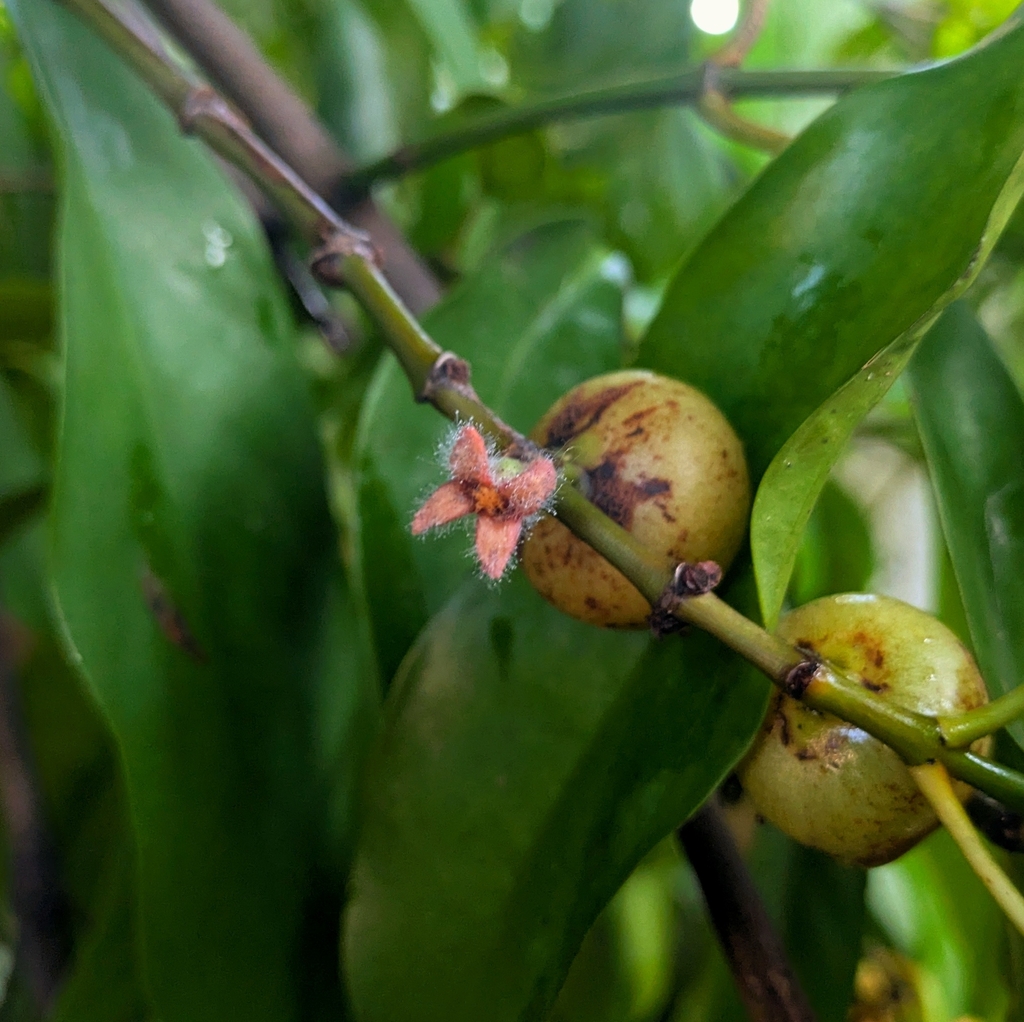
- Names in the book
- Binukaw, Tag., applied to both trees, though the first is also called Gatasan pulá in Tagalo and Taklag̃-anak in Pampango.
- Colours
- fruityellow, green
- Native range
- Philippines
- In the Philippines, per the book
- Very common throughout the islands, abounding in the mountains of San Mateo and Morong. Blooms in August.
- Family
- Clusiaceae, filed in the book under Guttiferæ
- Printed as
- Garcinia Cambogia, Desrouss. (Cambogia binucao, Blanco.)
- Sources
- Page 36 on Project Gutenberg · Wikipedia
The book prints Garcinia Cambogia and gives Blanco's Cambogia binucao as the same plant. That Philippine tree is now Garcinia binucao.
The plant today
Garcinia binucao is a species of flowering plant in the Clusiaceae family. It is commonly known as binukaw, takway or batuan, is a species of Garcinia endemic to the Philippines. It is not cultivated, though its edible fruits are harvested from the wild for use as a souring agent in some Filipino dishes.
Excerpt from “Garcinia binucao” on Wikipedia, CC BY-SA 4.0.
Recorded in the Philippines
GBIF holds 177 records of this plant from the Philippines. The ones with map coordinates fall in 13 provinces, most often Benguet (37), Palawan (11), Masbate (6), Davao del Sur (4), Bataan (2), Batangas (2), Bulacan (2), Laguna (2), and 5 more.
Counts from GBIF occurrence records, October 2026. They include planted trees and garden plants, and a province with no records may only lack collectors.
What the 1901 book says
A historical record, quoted as printed. Doses and remedies here are not medical advice.
The book gives one account for this plant and Gatasan (Garcinia venulosa), so the text below appears on each page.
Uses
The fruit of the second species, the true name of which is binucaw, is acid and edible. The fruit and the trunk of both species, when cut, exude a gum-resin very much like gamboge which is obtained from the G. morella or G. pedicellata, Desr. These gum-resins, however, seem to be much inferior to gamboge; they contain an essential oil which does not exist in the latter and their color is paler.
Botanical description
The G. venulosa is a tree with leaves opposite, lanceolate, acute, entire and glabrous, the inferior surface covered with nervelets which converge at the apex. Petioles short and flattened. Flowers tetramerous. Calyx, 4 persistent sepals. Corolla, 4 petals, overlapping, fleshy, ovate, of the same color as the calyx. Stamens numerous; no filaments; anthers round and very small. Style very short and thick, stigma peltate, divided into 10 parts. Fruit globose, depressed, no well-marked ridges when ripe.
G. Cambogia differs from the foregoing in the leaves which present no nervelets on the lower surface and the fruit which presents 8 angles or rounded ridges.
Recent research
The most cited papers since 2022 that name this plant in the title, pulled from Europe PMC in October 2026. Titles are the authors' own and the findings have not been reviewed here.
All 1 results on Europe PMC