Kulantro
Coriandrum sativum · Coriander
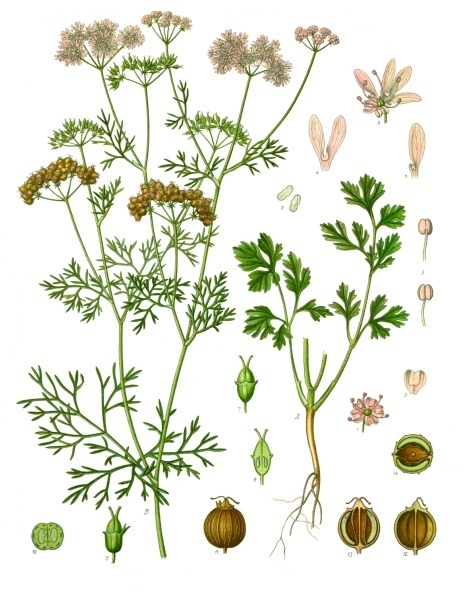
- Names in the book
- Cominos, Calantro, Sp.; Coriander, Eng.
- Used for
- Stomach and digestion
- Colours
- flowerwhite, pink
- Native range
- Mediterranean and Southwest Asia
- In the Philippines, per the book
- Common, cultivated in the gardens and well known.
- Family
- Apiaceae, filed in the book under Umbelliferæ
- Printed as
- Coriandrum sativum, L. (Cuminum cynimum, Wall.)
- Sources
- Page 137 on Project Gutenberg · Wikipedia
The plant today
Coriander, or Coriandrum sativum, is an annual herb in the family Apiaceae. The leaves are known as cilantro in the US. Most people perceive the leaves as having a fresh, slightly citrus taste. Due to variations in the gene OR6A2, some people perceive its flavor to be more soaplike or rotten. The species is native to the Mediterranean Basin. All parts of the plant are edible, with the fresh leaves and dried seeds most traditionally used in cooking. It is included in Peruvian, Mexican, Indian and Southeast Asian cuisines.
Excerpt from “Coriander” on Wikipedia, CC BY-SA 4.0.
Sa Tagalog
Para sa ibang gamit ng kintsay, tingnan ang kintsay (paglilinaw). Ang unsoy, silantro, o kulantro (Coriandrum sativum; Ingles: coriander, cilantro o Chinese parsley) ay isang uri ng maliit na halamang nagagamit na pampalasa sa mga lutuing pagkain. Umaabot sa magpahanggang sampung desimetro ang taas nito. Kulay pula ang mga bulaklak nito, samantalang kayumanggi naman ang mga butil ng buto. Isa itong halamang nabanggit sa Tanakh at sa Bibliya.
Sipi mula sa “Unsoy” sa Tagalog Wikipedia, CC BY-SA 4.0.
Recorded in the Philippines
GBIF holds no records of this plant from the Philippines.
Checked against GBIF occurrence records, October 2026.
What the 1901 book says
A historical record, quoted as printed. Doses and remedies here are not medical advice.
The book gives one account for this plant and Anis (Fœniculum vulgare), so the text below appears on each page.
Uses
The fruit of both species has the same therapeutical application being stomachic and carminative par excellence. It yields an aromatic essential oil with stimulant properties, popular because of its agreeable odor and taste.
As a rule the infusion is given in doses of one liter a day (15–30 grams of the seeds to one liter of water). The essence and the alcoholate are also employed, the former obtained by distillation, the latter by macerating the fresh seeds in alcohol. The dose of the essence, 4–8 drops on a piece of sugar or in potion; the alcoholate, 2–10 grams in sweetened water or infusion of aromatic herbs.
Both plants are official in the Spanish Pharmacopœia and they and their preparations are common in all drug stores.
Botanical description
F. vulgare: Aromatic, stout, smooth herb, 4–6° high. Leaves with many slender thread-like divisions. Large umbel of yellow flowers, no involucre and no involucels. C. sativum: Low aromatic herb, leaves pinnately compound, small umbels with few rays, flowers white.
Recent research
The most cited papers since 2022 that name this plant in the title, pulled from Europe PMC in October 2026. Titles are the authors' own and the findings have not been reviewed here.
- Selenium nanoparticles reduced cadmium uptake, regulated nutritional homeostasis and antioxidative system in Coriandrum sativum grown in cadmium toxic conditions
- Titanium dioxide nanoparticles mitigate cadmium toxicity in Coriandrum sativum L. through modulating antioxidant system, stress markers and reducing cadmium uptake
- Essential Oil from Coriandrum sativum: A review on Its Phytochemistry and Biological Activity