Kalingag
Cinnamomum pauciflorum
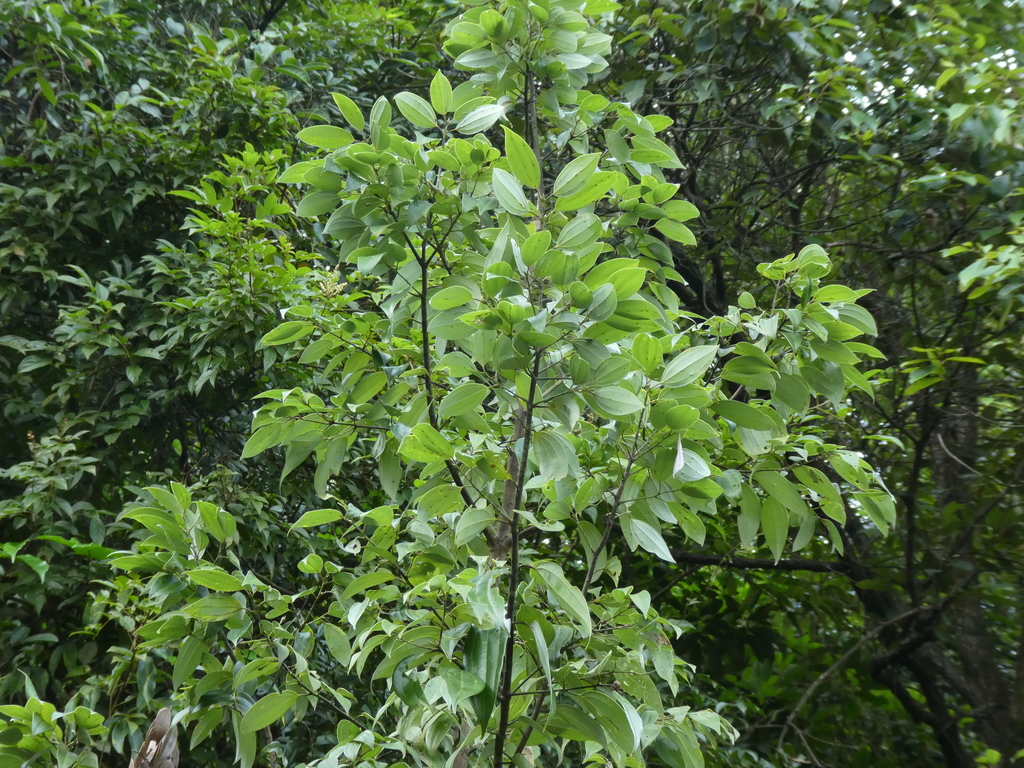
- Names in the book
- (of both).—Kalig̃ag, Makalig̃ag, Tag., Vis.; Kandaroma, Iloc; Cassia Lignea or Cassia, Eng.
- Used for
- FeverDiarrhea and dysentery
- Colours
- flowercream
- Native range
- Nepal and northeast India to Myanmar and southern China
- In the Philippines, per the book
- Both species are common in the forests of Luzon. The first species blooms in May, the second in January.
- Family
- Lauraceae, filed in the book under Lauraceæ
- Printed as
- Cinnamomum pauciflorum, Nees. (Laurus culilaban, Var., Blanco.)
Blanco's kalingag, which the book splits between this name and Cinnamomum tamala, is now Cinnamomum mercadoi, a Philippine endemic.
The plant today
The native range of this species is Nepal to S. China. It is a tree and grows primarily in the subtropical biome.
From Plants of the World Online, Royal Botanic Gardens, Kew, CC BY 3.0.
What the 1901 book says
A historical record, quoted as printed. Doses and remedies here are not medical advice.
The book gives one account for this plant and Kalingag (Cinnamomum tamala), so the text below appears on each page.
Uses
The bark of both species is known in pharmacy as Chinese cassia or Chinese cinnamon (cassia cinnamon). Indeed it is very like the cinnamon of Ceylon, comes in curled quills, has the same odor and taste though not so delicate; but it is darker in color, with a surface less clean and smooth. Its chemical composition is identical with that of the latter and nowadays it forms an important article of commerce.
Cinnamon renders good service in therapeutics as a stimulant of the digestive tract and a heart tonic. In the atonic diarrhœas so common in the Philippines a tincture of cinnamon in doses of 8–10 grams a day, or the powder in cases where alcohol was contraindicated, have given me unhoped-for results.
In Spain and the Philippines it is very popular as a condiment in the kitchen of the confectionery and as a flavor for chocolate; in fact in those countries it takes the place of vanilla in France. It enters into the composition of several elixirs and compound tinctures, such as “Botot’s Water” (dentifrice), “Elixir of Garus” (tonic stimulant), “Balsam of Fioraventi” (external stimulant), laudanum and the elixir of the Grande Chartreuse (diffusible stimulant).
Lately it has been demonstrated that the essence is a powerful antiseptic, in the presence of which typhoid fever bacilli cannot develop.
Botanical description
A tree, 15–20° high. Leaves opposite, lanceolate, 3-nerved, entire, glabrous. Flowers yellow, paniculate, umbellate. Common peduncles very long, those of the flowerets long. Calyx none. Corolla, 6 ovate, hairy petals. Stamens 9; 6 external to the rest and bearing the anthers, 4 on each filament, 2 below the others; the 3 inner stamens bear 2 anthers each.
In the second species the flowers form loose, terminal panicles. Stamens 9; 6 filaments inserted on the receptacle, spatulate, each bearing 4 anthers on the inferior face; the other 3 filaments thick, each bearing 4 anthers. Between the last filaments are 8 nearly globose glandules.
Recent research
The most cited papers since 2022 that name this plant in the title, pulled from Europe PMC in October 2026. Titles are the authors' own and the findings have not been reviewed here.
- Mechanistic insights on cytotoxicity of KOLR, Cinnamomum pauciflorum Nees leaf derived active ingredient, by targeting signaling complexes of phosphodiesterase 3B and rap guanine nucleotide exchange factor 3
- The chloroplast genome of aromatic plants Cinnamomum pauciflorum (Lauraceae)