Lagtang
Anamirta cocculus · Fish berry
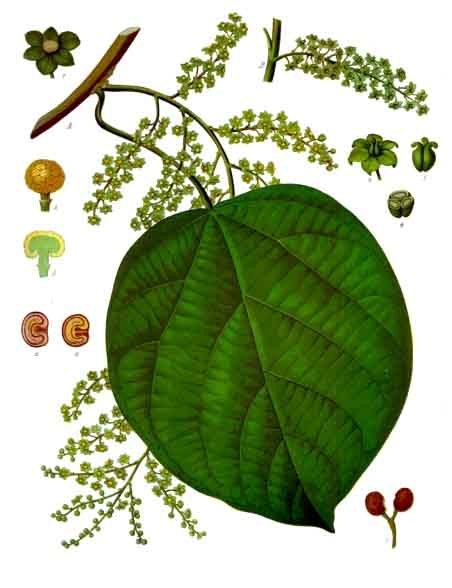
- Names in the book
- Laktag̃, Liktag̃, Suma, Lanta, Lintag̃ bagin, Tuba, Balasin, Bayati, Tag., Vis., Pam.
- Colours
- flowergreenish-yellowfruitpurple, black
- Native range
- India and Southeast Asia
- Family
- Menispermaceae, filed in the book under Menispermaceæ
- Printed as
- Anamirta Cocculus, Wight & Arn. (Menispermum Cocculus, (L.) Blanco; M. lacunosum, Famk; Cocculus lacunosus, C. suberosus, DC.)
- Sources
- Page 24 on Project Gutenberg · Wikipedia
The plant today
Anamirta cocculus (Marathi: काकमारी) is a Southeast Asian and Indian climbing plant. It is the source of picrotoxin, a poisonous compound with stimulant properties. The plant is large-stemmed (up to 10 cm in diameter); the bark is "corky gray" with white wood. The "small, yellowish-white, sweet-scented" flowers vary between 6 and 10 millimeters across; the fruit produced is a drupe, "about 1 cm in diameter when dry".
Excerpt from “Anamirta cocculus” on Wikipedia, CC BY-SA 4.0.
Recorded in the Philippines
GBIF holds 94 records of this plant from the Philippines. The ones with map coordinates fall in 9 provinces, most often Antique (4), Davao del Sur (3), Agusan del Norte (2), Laguna (2), Batangas (1), Abra (1), Camarines Sur (1), Cavite (1), and 1 more.
Counts from GBIF occurrence records, October 2026. They include planted trees and garden plants, and a province with no records may only lack collectors.
What the 1901 book says
A historical record, quoted as printed. Doses and remedies here are not medical advice.
Uses
One of the uses to which the India berries (Cocas de Levante) are put in the Philippines, is to throw them into small sluggish streams or into lakes with the object of intoxicating the fish which soon come to the surface and float there as if dead. This custom is very extensive in Malaysia, in India and even in Europe, where, in order to avoid the cases of poisoning which this practice has occasioned in the consumers of fish taken in this way, it has been found necessary to forbid the sale of the berries except in the pharmacies. These restrictions are practiced in France.
In the Binondo market in Manila the root of this plant may be found in abundance; it is yellow and very bitter. The natives use the infusion (5–10 grams to 300 cc. of water) in fevers, dyspepsia and menstrual derangements. In India also the root is used in the same complaints.
The fruit contains the highly toxic principle picrotoxin, and others as follows:
Menispermin (C18H24N2O2) is an alkaloid which crystallizes in pyramidal prisms, is soluble in alcohol and ether and insoluble in water. Hot nitric acid converts it into oxalic acid and a yellow substance of a resinous appearance.
Picrotoxin (C30H24O13) is not an alkaloid as may be seen from its formula. Its properties are not well known at the present time. It crystallizes in small quadrilateral prisms, white and transparent, or in needles grouped in stars. No odor, taste bitter, insoluble in water, partly soluble in alcohol and in ether, freely soluble in acids and alkalies. A solution in concentrated sulphuric acid has a saffron-yellow color. Nitric acid transforms it into oxalic acid.
Picrotoxinin exists in picrotoxin in the proportion of 32 to 100, and may be separated by boiling in benzine. It is bitter, poisonous, reduced by Fehling’s solution and nitrate of silver. Sixty-six per cent. of picrotoxin consists of another bitter substance, non-poisonous—picrotin, which is insoluble in benzine and is reduced by Fehling’s solution and nitrate of silver. Lastly, anamirtin is found in the mother water of picrotoxin; it is not bitter, not poisonous, and not reducible by the aforementioned reagents.
The fruit of the anamirta, the “coca de Levante” is an acrid, narcotic poison, which may not be employed internally; its uses are limited to external medication. In the Pharmacopœia of India is given the formula for a parasiticide ointment, highly recommended in the treatment of pediculi:
Unguentum anamirtæ:
[table omitted; see the source text]
In applying this ointment it is necessary to make sure that there is no wound or abrasion of the skin through which absorption might take place.
Botanical description
A vine with leaves alternate, entire, glabrous, broadly oval, pointed, with 5 nerves which unite at the base, long petioles. Flowers diœcious, in compound racemes. Male flowers consist of a perianth without corolla, the sepals arranged by threes in two or three whorls. The end of the receptacle expanded like a bead, bears a large number of stamens in 6 vertical series, with anthers sessile and 4-lobed. Female flowers analogous as regards the perianth, with 6–9 sterile stamens. Carpels formed of 5 ovaries, free, unilocular, containing one ovule each. Fruit, a drupe of a purple color, the size of a filbert, kidney-shaped, the albumen horny.
Recent research
The most cited papers since 2022 that name this plant in the title, pulled from Europe PMC in October 2026. Titles are the authors' own and the findings have not been reviewed here.
- In silico evaluation of binding of phytochemicals from bayati (Anamirta cocculus Linn) to the glutathione-s-transferase of Asian Corn Borer (Ostrinia furnacalis Guenée)
- Unveiling the anticancer potential of Anamirta cocculus (L.) Wight& Arn.: Evidences from cytotoxicity studies, apoptosis analysis, and molecular docking
- Loop-mediated isothermal amplification (LAMP) for quality control of Coscinium fenestratum: a colorimetric platform for detecting Anamirta cocculus adulteration