Bias-pugo
Ammannia baccifera · Blistering ammannia
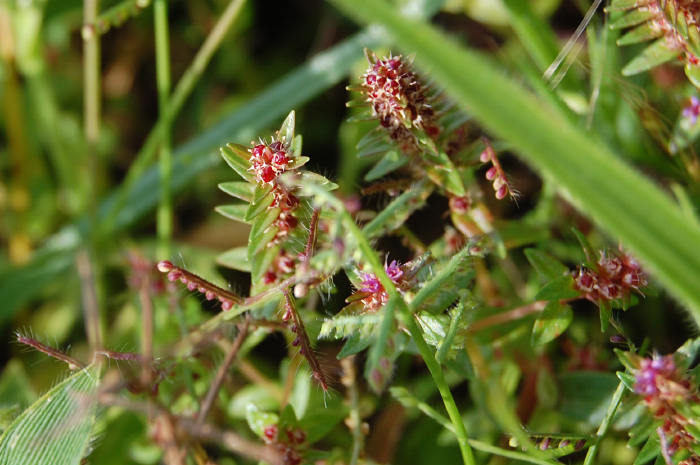
- Names in the book
- Bias pogo, Tag.; Blistering Ammannia, Indo-Eng.
- Colours
- flowerredfruitred
- Native range
- Old World tropics
- In the Philippines, per the book
- It grows in the marshes of Mandaloyon.
- Family
- Lythraceae, filed in the book under Lythraceæ
- Printed as
- Ammannia vesicatoria, Roxb. (A. baccifera, L.; A. Indica, Lam.; A. debilis and Celosia mana, Blanco.)
- Sources
- Page 117 on Project Gutenberg · Wikipedia
The plant today
Ammannia baccifera, also known as the monarch redstem or blistering ammannia, is a species in the family Lythraceae. It is widespread in the tropical regions of Asia, America and Africa. It has been naturalized in Spain. It is annual and herbaceous, and can be found in marshes, swamps, rice fields and water courses at low elevations. It is considered endangered in Israel, but because it is widespread and common elsewhere, the IUCN considers it to be 'Least Concern'. The plant Ammannia baccifera Linn. is erect, branched, smooth, slender, annual, more or less purplish herb 10 to 50 centimeters in height. The stems are somewhat 4-angled.
Excerpt from “Ammannia baccifera” on Wikipedia, CC BY-SA 4.0.
Recorded in the Philippines
GBIF holds 57 records of this plant from the Philippines. The ones with map coordinates fall in 4 provinces: Metropolitan Manila (2), Capiz (1), Nueva Ecija (1), Quezon (1).
Counts from GBIF occurrence records, October 2026. They include planted trees and garden plants, and a province with no records may only lack collectors.
What the 1901 book says
A historical record, quoted as printed. Doses and remedies here are not medical advice.
Uses
The leaves contain an irritant and acrid principle that renders them vesicant when applied to the skin. The Pharmacopœia of India quotes Sir W. O’Shaughnessy to the effect that plasters made of the bruised leaves even when renewed every half hour require 24 hours to raise a blister and at the same time cause severe pain. He found it much more painful than cantharides and much less prompt to act. Dr. Dymock has prepared an ethereal tincture of the leaves and obtained with it results very different from those just mentioned; this is not surprising in view of the fact that the tincture holds in solution in a small quantity of ether, a considerable amount of the vesicant principle. This tincture has the same color as the “epispastic” of the English Pharmacopœia, causes less pain and rapidly raises a good blister, facts of which I have convinced myself by the use of a small quantity sent me from Bombay in 1891.
Dr. Bholanauth Bose recommends the internal use of the juice of the leaves as a remedy for chronic diseases of the spleen; this treatment, however, has caused severe pain and is absolutely uncertain in effect.
In Concan the juice of the leaves is given mixed with food to animals in heat, for its anaphrodisiac action. The fresh or dried plant is given in decoction mixed with ginger in intermittent fevers.
If the ethereal tincture be evaporated a resinous residue remains that has not been studied, but appears to be the vesicant principle. This tincture should be made from the dried leaves to avoid hydration of the ether.
Botanical description
A small plant with stem red, straight, quadrate, ramose. Leaves opposite, lanceolate, and fringed with hairs. Flowers axillary, small, red, solitary. Peduncles short. Calyx inferior, bell-shaped, with 8-toothed border, the 4 alternate teeth larger. Corolla none. Nectary bell-shaped, surrounding the ovary, shorter than the calyx, with 4 toothlets which lengthening form the filaments of as many stamens. Anthers 4-celled. Ovary of 4 pluriovulate locules. Style almost wanting. Stigma fluted. Seed vessel glabrous, horizontally dehiscent, containing 15 or more angular seeds joined to a common axis.
Recent research
The most cited papers since 2022 that name this plant in the title, pulled from Europe PMC in October 2026. Titles are the authors' own and the findings have not been reviewed here.
All 1 results on Europe PMC