Saga
Abrus precatorius · Rosary pea
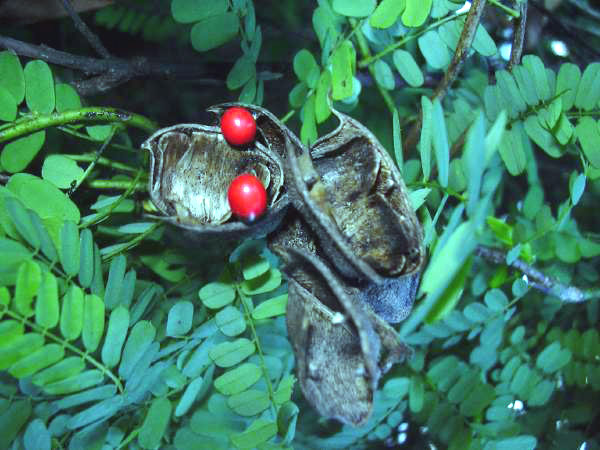
- Names in the book
- Saga, Sagamamin, Bag̃ati, Tag.; Bag̃ati Gikosgikos, Vis.; Kanaasaga, Pam.; Bugayon, Iloc.; Jequiriti, Prayerbeads, Eng.
- Colours
- flowerpink, lilacseedred, black
- Native range
- Old World tropics
- In the Philippines, per the book
- Common in all mountainous regions of the islands. Grows near houses and roads.
- Family
- Fabaceae, filed in the book under Leguminosæ. (Papilionaceæ.)
- Printed as
- Abrus precatorius, L.
- Sources
- Page 88 on Project Gutenberg · Wikipedia
The plant today
Abrus precatorius, commonly known as jequirity bean or rosary pea, is a herbaceous flowering plant in the bean family Fabaceae. It is a slender, perennial climber with long, pinnate-leafleted leaves that twines around trees, shrubs, and hedges. The plant is best known for its seeds, which are used as beads and in percussion instruments, and which are toxic because of the presence of abrin. Ingestion of a single seed, well chewed, can be fatal to both adults and children. The plant is native to Asia and Australia. It has a tendency to become weedy and invasive where it has been introduced.
Excerpt from “Abrus precatorius” on Wikipedia, CC BY-SA 4.0.
Recorded in the Philippines
GBIF holds 175 records of this plant from the Philippines. The ones with map coordinates fall in 24 provinces, most often Palawan (5), Batangas (4), Pangasinan (3), Rizal (3), Bataan (2), Bohol (2), Cagayan (2), Davao del Sur (2), and 16 more.
Counts from GBIF occurrence records, October 2026. They include planted trees and garden plants, and a province with no records may only lack collectors.
What the 1901 book says
A historical record, quoted as printed. Doses and remedies here are not medical advice.
Uses
The part of the plant most important in therapeutics is the seed, the size of a small pea, bright red with a black spot, hard and shining. The Filipino children use them to make rosaries and other decorations. In the distant past the Filipinos used these seeds to weigh gold, a practice followed even to-day by the Hindoos. The famous Susrutas, author of the “Ayur Veda,” recommends them internally for nervous diseases; modern therapeutics, however, limits their use to one disease, though that is frequent and stubborn enough, namely chronic granular conjunctivitis.
Some physicians state that these seeds are poisonous and others the contrary, but the fact that they are used as food among the poor classes of Egypt, demonstrates their harmlessness in the digestive tract at least; when introduced into the circulation they undoubtedly exercise a toxic effect. We have already mentioned that their use is limited nowadays to the therapeutics of the eye; the decoction of the seeds known in Europe under the name of “Jaqueriti”—so named in Brazil—produces a purulent inflammation of the healthy conjunctiva and it is precisely this counter-irritant effect which makes it useful in chronic granular conjunctivitis, the persistence of which has defied the most heroic measures of therapeutics. The French oculist, Dr. de Wecker, was the first to employ jequirity for this purpose, in the form of a 24 hours’ maceration of the seeds, 10 grams to 500 grams of water. It is necessary to use a product recently prepared and with this several applications a day are made. It is now known that the inflammation of the healthy conjunctiva is not caused by germ-life contained in the solution but by an inorganic ferment discovered by Bruylans and Venneman and named jequiritin; they state that it is produced during the germination of the seeds or of the cells in the powdered seeds. Warden and Waddell, of Calcutta, have isolated an essential oil, an acid named “ábric” and an amorphous substance called abrin, obtained by precipitation with alcohol from a watery infusion of the pulverized seeds. Its action is identical with that of “jequiritin.”
The infusion appears to possess considerable value as a stimulating application to indolent ulcers.
The root is a good substitute for licorice, is emollient and has an agreeable taste. The extract is useful in catarrhal diseases of the bronchi and in dysuria. The leaves contain the same properties as the root and an extract prepared from them is used as a substitute for licorice.
Botanical description
A vine, with leaves opposite, abruptly pinnate, a stylet taking the place of the terminal leaflet. Leaflets linear, entire, glabrous, tipped with a small point. Common petiole with 2 awl-shaped stipules at the base. Flowers in small racemes. Calyx gamosepalous, caducous, 4–5 short teeth. Corolla papilionaceous, wings horizontal. Stamens 9, monadelphous with bilocular anthers. Style very short. Stigma globose. Pod 4–5 cm. long, truncate at the ends, with 5–6 red seeds, each with a black spot.
Recent research
The most cited papers since 2022 that name this plant in the title, pulled from Europe PMC in October 2026. Titles are the authors' own and the findings have not been reviewed here.
- Integrating Network Pharmacology and Molecular Docking Approaches to Decipher the Multi-Target Pharmacological Mechanism of Abrus precatorius L. Acting on Diabetes
- Green Synthesis of Magnesium Oxide Nanoparticles by Using Abrus precatorius Bark Extract and Their Photocatalytic, Antioxidant, Antibacterial, and Cytotoxicity Activities
- The traditional uses, phytochemistry and pharmacology of Abrus precatorius L.: A comprehensive review